
Applications Open for $50,000 Crux for a Cause
KANSAS CITY, Mo. – Crux KC has officially opened applications for its annual Crux for a Cause progra...

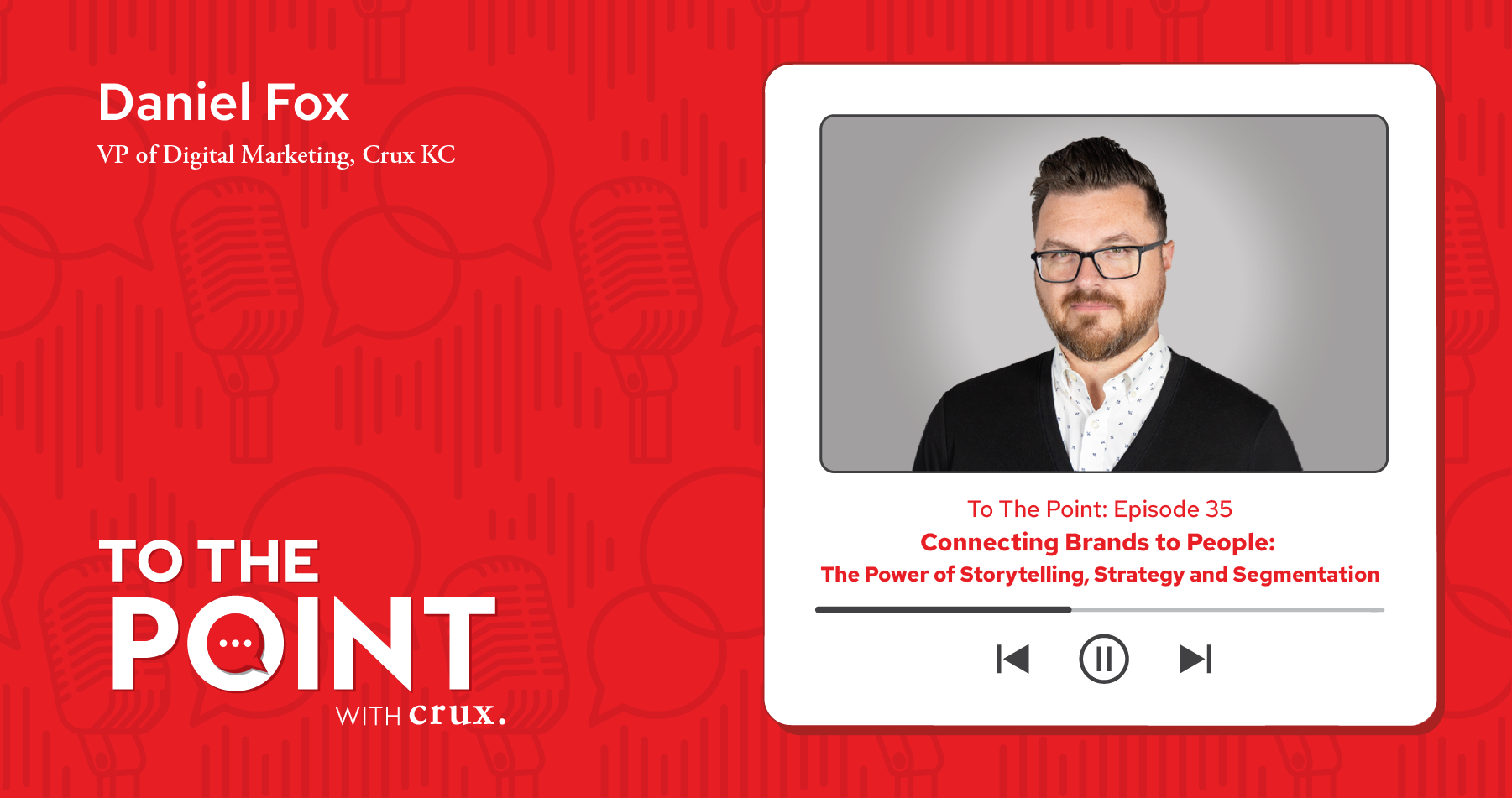
Ethan Whitehill: Hi everyone. Welcome to our podcast “To the Point.” I’m Ethan Whitehill, president and chief strategy officer of Crux, the “un-agency.” We produce this monthly podcast to bring you thought-provoking conversations that get to the crux of it and help entrepreneurial brands fuel growth. Our guest for episode 35 is Crux’s own Daniel Fox. Daniel Fox recently joined Crux as VP of digital marketing, a strategic innovator at the crossroads of storytelling and technology. Daniel brings more than 20 years of experience in digital marketing with a solid record of driving growth in a variety of industries, including consumer products, energy, FinTech, gaming, and publishing. Before joining Crux, Daniel served as executive creative director at Andrews McMeel Publishing, and later served at University Games where he launched and marketed, acclaimed multiple award-winning game products, and one I found super interesting related to Dungeons & Dragons. We’ll get to that in a second when I pull my 20-sided die up later.
Daniel Fox: Thank you for having me today. I’m really excited to talk. I was discussing with Josh earlier about the podcast, and he mentioned that we don’t really pull a lot of people in from Crux sometimes for the interviews. I’m really excited to talk today.
Ethan Whitehill: To get us started. Now let’s talk about your background, dive into your history a little bit. Tell our listeners about your career journey and what brought you to Crux.
Daniel Fox: So, I started way back in the ‘00s during the .com bust days, and I was working for a little agency here in Kansas City that had mastered the very first banner ad placed on Yahoo. You probably remember it as that monkey that kind of goes back and forth. You had to punch ,and it would take you to place called treeloop.com, and they would scrape co-registration data. This is the very early days of like the, of like the .com bust. I still have the costume, by the way, in my basement. I will show it to you. It’s kind of wild. So, I spent my number of years there. I worked my way through on traffic coordination. I was doing copywriting eventually I fell into a graphic designer role. My goal at the time was like, “let me master as many disciplines as I possibly can,” because I was just so eager to learn and soak it all in. In my time there I was a director of media buying. You know, this was way back when most of our focus was on email, and that was kind of the backbone of where I kind of moved throughout the rest of my career. I spent a lot of time in consumer products, a lot of time in-agency. My agency time was spent at VML here in Kansas City. I worked for a couple of smaller lead-generation outfits here and in Overland Park. And eventually I find myself with this really interesting crossroads. I was writing and producing games on my own. It was during the night when the sun went down but during the day, I was living this role as a director of marketing and media. And then my publisher said, “we want to build a games department.” And they were my publisher. They’re like, “we want you to be a part of it.” So, I had some time at Andrews McMeel, but I found myself inevitably going back to my background–the marketing, digital marketing, email, how to connect with consumers. I like creating meaningful stories. So ,I think that the overarching story here is like, I like telling, I like storytelling, and I’ve found a way to kind of merge those two things. And that’s actually kinda one of the things that brought me to Crux is that it was such a very different approach. The “un-agency” approach. It’s not just a byline; it’s actually real. Having experienced it now for 11 weeks, I get to bring these like worlds together where I can tell great creative stories and exist in the digital space, and most importantly, tell, bring these stories to people who want to hear them and connect brands with people. That’s the thing I think kind of is the undercurrent of my entire career, is that that’s the thing that really drives me and why I’m here, because it’s the opportunity to do that for some really fun clients here in Kansas City and beyond.
Ethan Whitehill: Well, we’re thrilled to have you on the team and you added value on day one. You know, you hit the ground running ,and we’re excited to continue your storytelling journey with us. Thank you for that history too. As you kind of walked us through it, I’m going to take us fast forward into today and 2025 as we round the bend on this year. And, in thinking about what some of our clients are thinking about, what should these businesses be doing now to set themselves up for a great 2026 as we’re all making our resolutions and thinking future forward on the next year? What do you recommend?
Daniel Fox: We’re getting toward the end of the year, which I think a lot of companies are asking themselves, “okay, what’s my budget going to be for next year? What are we going to plan for?” So a lot of that early campaign thinking has probably already happened. So, this latter part of the year–November, December–it’s an opportunity to start tightening up your fundamentals. So, I see it from the perspective of cleaning up your data, make certain that you’ve got all of the data points that you need to connect with the customer. Do you have, as an example, if you are targeting people in the Kansas City area, are you sure you’ve got those people in your email list. For the purposes of your tech stack, it’s time for a good audit. It’s a good time to take a look at the technology, look at it in our rears and say, “is this really doing the thing I needed to do?”
For me, I think about from the perspective of email service platforms like MailChimp and Klayvio and Constant Contact, as your list continues to grow and you continue to create these consumer journeys to story tell to your customers and pull them through proof points, it’s a good time to really examine your cost you’re spending, if it’s going to be able to fulfill your goals as you begin to expand and grow. I think about the sharpening of your message. It’s always a good time to make certain that your messages are really resonating, both from a paid and organic perspective. What do your open and engagement rates really look like, and how can all of that data inform what you do next year? How do you deliver that message? Does it need to change and adapt? Are there competitors in this space?
But most importantly, setting measurable goals, right? I think we’d all like to believe we just double revenue the following year, or even triple revenue would be an amazing goal, right? The reality is you can’t do that unless you’ve tightened up your fundamentals. And that I think is the things that you should be doing in November and December, leading into next year.
Ethan Whitehill: I have to ask this question so we can get it out of the way. AI is the hot topic, obviously. And if you think about it for most folks today, they’re experimenting with ai. They’re trying to figure out, “what is the best way to apply this to my business?” And as we think about marketing in particular, how would you say AI is transforming marketing efficiency and freeing up time for humans to do the creative work?
Daniel Fox: I’m of two minds on this. This is a complicated topic for me from a personal perspective. One, I’m an art school dropout. So, from a creative perspective, I’m like, “oh my gosh, ai, it’s imminent.” But the reality is–I think the point you brought up which is–how do we get the heavy lifting off of our team by using ai? Can we speed up research and reporting when it comes to content drafting and even, you know, some from some forms of production. It kind of frees up our minds to really focus on the creative side, the strategic side, and on the relationship building. To me, those are things that machines can’t replicate yet, hopefully never. But I think that once again those are tools that can really kind of get the rote tasks off of our desk and help us drive toward, again, you know, more meaningful stories that still need human contact.
It still needs human input, and AI is imperfect. Again, there are many AI tools that can get us to where we need to get to from a creative perspective, but I find AI most useful to do the heavy lifting when it comes to reporting to help me draw insights that I need from a giant Excel sheet as opposed to spending hours building a pivot table and trying to spit out like meaningful insights. I can use ai. I can use copilot and have it be informed of the way I look at data to give me the things that I need to start decision making.
Ethan Whitehill: So, speaking of those decisions and changing gears a little bit. There are so many channels that brands can leverage. So, I imagine some of the data that we’re looking at with AI is really identifying what are the best performing channels and how do we improve them and optimize them as we move forward? But there is one channel that doesn’t get a lot of love–you mentioned as you were talking earlier in your bio–and that’s email. I know there’s a special place in your heart for email. There’s actually a special place in a lot of marketing plans for email, but it’s been somewhat neglected, I think, by a lot of marketers because of shiny objects like ai. So, talk to us a little bit about that vital role that email can play in a good marketing strategy.
Daniel Fox: Yeah, so I think about it from two perspectives. The first off is like, as an employee of Crux. The first thing I do when I walk in the morning is block and tackle. I go through my email to see what needs to be prioritized, what doesn’t need to be prioritized, personal messages I typically prioritize for during the lunch hour. Abby who works here has a really interesting little sticker on her by your desk that says, email is a D&D combat-based system. Meaning–which I think is brilliant because it’s a good analogy–what’s important, what’s least important? So, from that, from that perspective, email is vital for that. And when you think about it from a marketing perspective, the high level is here. That email has the highest ROI of any channel, period. When it comes to email and opt-in and CANSPAM, you own that customer. They’re in your list. You control it. You get to determine when you send to them, when’s the appropriate time to send to them, how to engage with them. And when it’s done right, it can build direct connections without relying on algorithms. You don’t have to earn this meeting. You already own it. It’s your responsibility to treat that lead, if you will, with care, with concern about not filling up their inbox so that they’re not doing the same thing we do every morning, which is block and tackle work email versus personal email.
Ethan Whitehill: I know going into the holiday season, I think I read consumers are going to receive 15 to 25% more marketing emails–wild. And that’s tricky territory. And maybe to borrow another D&D term here, how do you avoid the critical hit of being marked as spam? When you’re sending email during this heavy email period, do you just not send it? Are there ways to avoid that problem?
Daniel Fox: It’s a great question. I feel that when it comes to how you treat your customers and how you treat your email database, relevance is always going to beat frequency. You pointed out already we’re getting toward the holiday season. Everyone is increasing the number of emails that are going out. I don’t know about you, but I’ve gotten so many email messages about holiday offers–brands I love and engage with–but now I feel like they’re filling my inbox. I didn’t ask for this increase in frequency. So, when you think about how you engage with those audiences, think about relevancy. You need to think carefully about frequency. To your point, lots of emails are in the inbox. Timeliness is important. You should be able to intuit and know through your email service platform when people are most likely to open, the most likely to click that sort of sub subsegmentation and really honoring the preferences of that user, even though they’re not communicating to that to you directly. You should use those insights to really drive when it’s appropriate and the type of message that you’re sending to them. Again, relevancy always beats frequency. And at the end of the day, if every email feels like it’s written for that customer, written for them, it won’t even register as noise. It’ll be opened, it’ll be engaged with.
Ethan Whitehill: And I imagine those rules apply to brands that are B2B or brands that are B2C both, right?
Daniel Fox: Well, you could look at it from this perspective. So B2C in my mind is about emotion and speed. When can I get the thing that I want? And is it resonating with the things that I appreciate, the things that I like: the brands, the car, the toy, whatever it may be. B2B is a little different. B2B is really about trust and clarity, but the throughline is still the same. Talk to a person and not a segment. Because nobody wants to be marketed to like they’re just another demographic box.
Ethan Whitehill: You always think of B2C is very much moment of intent. It’s a timing thing and B2B is building long-term credibility and trust over time.
Daniel Fox: That’s right. Right. Yeah, that’s right.
Ethan Whitehill: So that gets us to the audiences. You mentioned data and segmentation earlier. Thinking about that aspect of email, how critical is the hygiene of your list?
Daniel Fox: At the end of the day, good data means better decisions. Having a clean list, accurate tags, thoughtful segmentation, really examining the behaviors of your customers or clients. And your email list allows you to send the right message to the right person at the right time. At the end of the day, if you’re taking the time to examine that, it’s going to improve performance of your email. It’s going to reduce wasted man hours, like the time it takes to create an email to the copy, to do the graphic design, to get the approvals, all that fun stuff. And most importantly, it keeps your brand credible to the end user. That, I think, is the most crucial. And again, I sometimes like an email. It’s like you don’t just walk up to somebody in the middle of the street and say hello and hold a conversation. We’re all doing a hundred different things. We’re on our way to the grocery store, we’re on our way to see our friends, we’re on our way to go to work. That’s why we have to be very cautious and cognizant of people’s time. And that goes back to proper segmentation. The email needs to go in their inbox when they’re most likely to open it, and it needs to be unobtrusive.
Ethan Whitehill: And I feel like that segmentation helps drive a lot of decisions in the initial strategy and on the backend you have analytics to improve that as you move forward. And you used a great analogy when we were talking before the recording here about the rug tying the room together.
Daniel Fox: Big Lebowski reference. Yeah.
Ethan Whitehill: Take us through that one.
Daniel Fox: You know, to me–and this goes for really all channels, email paid, organic, wherever you’re active online–analytics really makes everything cohesive. When we think about paid, organic, social, and email, they’re really all just set pieces until we really look at the data. It kind of shows you what’s working. We know which people are opening, if it’s email. Or if we’re actually getting a conversion from a click on a paid ad, we know what’s not. And unsubscribe is just as meaningful as a click, because now we’re beginning to learn a little bit more about the audience messages that don’t necessarily resonate with certain segments and really where to focus next? The data should inform our strategy. Data is the backbone of that. We should pull away some insights from that.
And it goes to the “what’s next? What do I do with this now that I know these things? What do I do with my email strategy now that I know I’ve got a large segment of users who are not resonating with this message. I don’t see a lot of opens, but the subject line isn’t working from a paid ads perspective. Is it geotag or geo targeted correctly from organic social? Why is this getting a lot of shares?”
Like those sort of things are useful points of interest to know. And tying those together and looking at it holistically and having that inform your digital strategy is absolutely key. So, I guess when I think of The Big Lebowski reference, like the rug really is data, it’s analytics, and it’s what you do with that. Because again, reporting metrics is important, but it’s not the reporting that’s important, it’s what do you do with that next. That I think is what distinguishes like good media versus great media,
Ethan Whitehill: And you need that view so you can understand the whole ecosystem. It’s forest from the trees, right? It’s kind of seeing it holistically as you make your plans and you optimize and move forward. Well, in the spirit of optimizing, we’re going to optimize our understanding of Daniel. And I am going to give you my secret question now,. I’m going to give you the honor since you’re a D&D guy. You know how to handle a 20-sided die. Roll that and tell me what number you come up with, and I’ll find the question that corresponds.
Daniel Fox: It’s not a 20, but it is a natural one. Is that right?
Ethan Whitehill: It is.
Daniel Fox: That’s a critical failure for those who aren’t in the nerd world.
Ethan Whitehill: Okay. Well, and as a natural one, you get a pretty terrible question which is, what’s your go-to karaoke song?
Daniel Fox: Oh my gosh, anything Phil Collins. I love Aha. I love like the early nineties–late eighties, early nineties music. I guess that would’ve been Genesis at the time. Like anything Phil Collins I go to in the rare times that my wife can drag me out to do karaoke. But you know, a couple drinks and I’m like, “okay, I’m ready.”
Ethan Whitehill: So generationally that surprises me. Phil Collins, as a reference for you.
Daniel Fox: I’m 48. You know I grew up in that music and you know, I think some of the first tapes I bought for my tape deck was Genesis.
Ethan Whitehill: Amazing.
Daniel Fox: Love that. That whole era of music is just like speaks to me. It’s the time of my youth that I remember being a child.
Ethan Whitehill: Thanks for joining us in the Stu-Stu Studio.
Daniel Fox: That’s good. I love it!
Ethan Whitehill: Daniel, how can listeners connect with you offline or online?
Daniel Fox: Yeah, LinkedIn is definitely the easiest place. I’m happy to connect with business owners here locally, but most importantly, you know, if you’re looking to build smarter and more human digital strategies here at Crux KC, you can reach me at daniel.fox@findyourcrux.com.
Ethan Whitehill: Great conversation.
Daniel Fox: Thank you, again Ethan. I appreciate it.


