Measure What Matters: Leveraging Data to Define Marketing Success
It’s no secret that data and analytics are essential to any business – especially in todayR...

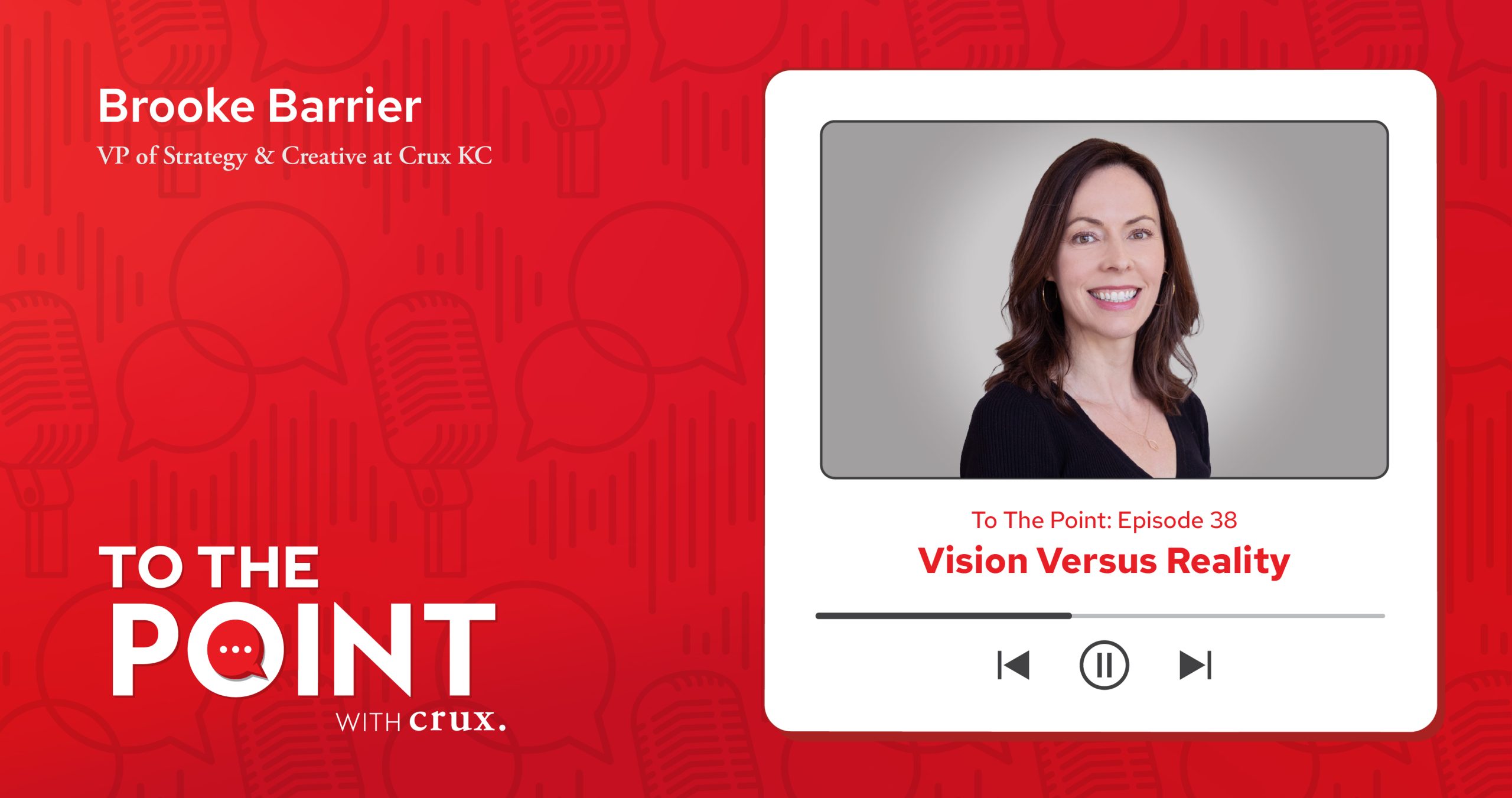
Does your brands perception of itself align with what your customers think? On the latest episode of To the Point, Ehtan Whitehill, President & CSO of Crux, speaks with Brooke Barrier, Crux’s VP of Strategy & Creative, about brand perception and how to find out what your clients and customers think of your business. Brooke is a brand strategist and content expert with experience crafting bold, insightful marketing for major brands.
Ethan Whitehill: Hi everyone. Welcome to our podcast, To the Point. I’m Ethan Whitehill, President and Chief Strategy Officer of Crux, the un-agency. We produce this monthly podcast to bring you thought provoking conversations that get to the crux of it and help entrepreneurial brands fuel growth. Our guest for episode 38 is Crux’s very own VP of Strategy and Creative, Brooke Barrier. Brooke is a brand strategist and content expert with a passion for crafting bold, insightful marketing that delivers real impact with expertise in brand identity messaging and full-funnel strategy, she blends creativity with data to help brands stand out and grow. She’s led creative and strategic projects for global giants like Microsoft, Humana, and Citigroup as well as local Kansas City favorites. A former journalist turned marketing leader, Brooke brings a sharp editorial eye and a deep understanding of audience engagement beyond work. She’s a dedicated community builder, having founded the KC Creative Mornings chapter and served on multiple nonprofit boards. So, you’re a busy person?
Brooke Barrier: I am. I am.
Ethan Whitehill: Brooke, welcome. Welcome to the show officially again. This is gonna be a lot of fun, and I’m just gonna jump right in if you don’t mind.
Brooke Barrier: Okay.
Ethan Whitehill: First question. You began your career in journalism. Help us connect the dots from journalism to marketing and branding.
Brooke Barrier: I started in journalism. I did grad school in Chicago at Northwestern, and, shortly after that, I moved out to New York, thinking I was gonna be a phenomenal journalist, which, for a while, it was very fun. I worked for a national trade publication for the food industry, and, when you’re 26, that was a blast because I got to go to the opening of Thomas Keller’s restaurants and, you know, all these sorts of fancy events and stuff. So, it was very fun and I did that for a number of years. Then—this is gonna show how old I am—blogging started. And, it was a really big thing, and a lot of the publishing industry started kind of suffering because of it, so here were a lot of struggles going on. I had a lot of friends working in magazines who were being laid off. And, at the time, I was also freelancing at an ad agency because I lived in New York, and I was in my twenties, and I needed to make enough money, so I did that in the evenings. So, I would go from my day job as a journalist to freelancing at night in an ad agency. And, when I kind of saw the writing on the wall with a lot of different layoffs, I was not laid off, but my company was doing fine, but I decided to go into advertising full-time. So, I started—actually—in pharmaceutical marketing and worked in that for a few years and while I was there, I had the opportunity to work on a couple of rebrands.
I just kind of fell in love with it. You know, I was really jazzed about learning so much about these companies in a different way or rebranding a product and really thinking so much about audience in a way that some of the campaign work I had been doing wasn’t delving into. So, a friend I was freelancing with at the time, she suggested I go and talk to some people at Interbrand who she knew. I did. It worked out. I went and started working for Interbrand in their verbal identity department, which is specifically focused on voice and messaging development, so we worked really closely with the strategy teams and the design teams, and we created brands and we got to work on some really cool projects. While I was there, I worked on the rebrand of Standard and Poor’s after they gave the U.S. a not-so-great rating and some pretty, pretty big projects that were not only related to what was going on in that organization at the time but felt a little bit more global and impact. So, it was something that felt very exciting to me and something that I just fell in love with.
Ethan Whitehill: And you and I have talked about one of the really cool things about branding is that we get to combine a lot of different disciplines—psychology, anthropology. You get to be sort of that anthropologist in the armchair, so to speak, and you learn about people and how they interact with products and companies.
Brooke Barrier: Well, when I was in college, I was really interested in psychology and anthropology. I was an English lit major and did kind of a double minor in psychology and anthropology, and I actually spent a semester abroad in Kenya. I always felt that I wanted to put myself in more challenging situations and really understand, you know, what makes a culture different? What makes the people tick? What are they driven by and how are they different from me potentially? So, I’ve always been really fascinated by that and just kind of the inner workings of the mind and how they play into culture and then how it all comes together. So, when I started working in branding, I felt this very almost felt like it was a synergy of all of those different things coming together, you know, my interest in writing and doing editorial and creative work, bridging the gap with psychology and anthropology. And then, as I got more invested in my career in branding, I started being looped in on different kinds of research—doing ethnographic research, doing qualitative studies. So, it really was kind of this blending of observing someone in their own space and time and then also talking to them about how they might be feeling about a certain thing and pulling all of that together. So, there’s this really cool mix of all of those different disciplines and branding, and I think that’s what’s kept me so excited about it and engaged in it for so long.
Ethan Whitehill: Yeah, marketing really is a social science in a lot of respects. Absolutely. And, you know, I think I wanna get back to some of those points that you’re making around culture and, you know, personality and how that influences brands and how people engage. But let’s start here. At its simplest level, what is a brand?
Brooke Barrier: I think that brand is—you know, I’ve heard it described a few different ways that I really like. One of my favorites is: “Brand is what people say about you when you’re not in the room.” So, I think that communicates something really clearly: That brand is a perception, and it’s a perception in the minds of your customer or your client if you’re a B2B organization, and it’s really driven by all of these foundational elements that you can establish as a company within your own organization and make sure that everybody is aligned on, but then it’s taken and it is interpreted by, you know, whoever it is that’s experiencing your brand. So, it’s kind of this living, breathing thing, which is really cool to me, and I think that that’s why I’ve always been so fascinated by branding.
Ethan Whitehill: I think most companies, whether they realize it or not, or they do it intentionally or not, but they’re creating a brand. They have a brand, and they may not see themselves the way other people see them, to your earlier point. But, you know, what do you think creates, maybe, that gap? You know, what—why is there a misunderstanding for most companies about their own brands?
Brooke Barrier: You know, I think a lot of leaders kind of fall in love with their vision. They fall in love with what they want the brand to be, but they don’t actually always take the time to validate what the market needs, and I think that is one of the biggest problems that we see today. Branding has become increasingly demanding because even though the psychology for branding has remained the same—people, they’re still gonna buy on emotion, followed by logic—the channels have changed dramatically with the introduction of AI and all of the different digital marketing options out there today. The pressure on building a brand or building a brand successfully and effectively has become much more extreme than it was in the past. Not only do you have to meet, you know, your customer at one or two or three places, you’ve gotta meet them everywhere they are and be top of mind all the time.
So, one thing I was just working on for one of our clients here, actually, is just thinking about three different areas where you can look at and evaluate brands. So, looking at brand purpose, and that’s kind of what you define internally, right? So, it can be your vision, your mission, your values, what you believe your core customer promises to your customer. Brand perception, which is what we were just talking about—so, that’s how people actually see you out in the world, you know, and what they’re kind of interpreting from you. And then there’s also brand expression, and so that actually is how you’re executing on all of those things that you think you’re doing really well, but then putting out into the world, and you kind of see, you know, are you doing it as well as you think you might be. So, if you look across purpose, perception, and expression, I think you get really holistically what you need to be successful across those three areas to have a very solid and cohesive brand.
Ethan Whitehill: And how do you know if you’ve landed in the right place at the end of all that?
Brooke Barrier: Well, there are a lot of different ways to figure that out. Some of the big companies invest in brand health reports, which is essentially doing quant studies and kind of looking at what your brand perception is in the market. They can actually study that and determine how people see you and what they think about your company and your organization. There are other ways to do it. You can do it through social listening tools. So, a lot of companies like Starbucks and some of the bigger brands like that, they do it a lot—a lot of social listening just to see what that common perception is, and I think that you always have to take kind of what you’re hearing externally and then reflect on it internally and make sure that you are continuing to be flexible. And, that’s an interesting thing with branding. I think a lot of people believe that once you get a brand guideline and you have this kind of set of rules and principles that it might start to feel rigid, but the whole purpose of a brand that’s done really well—where you actually have a very defined and well thought out strategy—is to allow the brand to flex and to adapt and to be more agile, so that you can reach your audiences where they are.
Ethan Whitehill: It seems like you have to strike a balance though—like for consumers or customers, you know, B2B audiences, consistency is also trust, right? If they know how you’re gonna show up every time —
Brooke Barrier: Absolutely
Ethan Whitehill: It makes their choice a lot easier. At the same time, you have—to your comment, you have to be flexible, you have to be agile, and you have to transform over time to meet your audience where they are. So, knowing all that— What’s something that clients don’t want to hear but often need to about their brand?
Brooke Barrier: I think the biggest thing is probably about consistency of execution and brand clarity. Brand clarity I think is something that a lot of companies struggle with. We live in an omnichannel world, and you have to maintain the same vision and values and brand personality across all of these different channels. And I think that that can be very challenging, and it’s very easy for your message to get muddied at this point. So, I think that oftentimes one of the biggest things we see is that lack of brand clarity. So, we’re continually telling clients, you know, you’re lacking in clarity in terms of what you do or how you’re delivering it or really, truly oftentimes it’s what’s the benefit to your end client. We also see a lot of inconsistency with consistency. So, you know, again, just because of multi-channel execution, I think that can be really challenging for a lot of our clients and a lot of companies out there today.
Ethan Whitehill: So, thinking about some of the things that we uncover when we do a branding project for a client, you know, we have a research phase where we do deep dives into their customers, we look at their competitors, we look at the category and sort of the wider context of the market and what’s happening, and I think sometimes we realize that, you know, there might be some business clarity issues beyond brand clarity issues. And so, how do we have those conversations when we find that, like, what does that sound like with a client, typically?
Brooke Barrier: Depending on what the business issue is, right? I mean, it could be something where they have not thought through their product development well, or it could be something where they’re offering a service line that is no longer relevant to their audience. Another thing that we come up across frequently is struggling with brand architecture. So, how do all of their different companies and families of brands relate to one another?
Ethan Whitehill: I’m gonna, can I pause you right there?
Brooke Barrier: Sure.
Ethan Whitehill: Because I think it’d be worth maybe defining for folks what brand architecture is, ’cause you and I talk about it all the time. But maybe for someone who isn’t familiar with that term—
Brooke Barrier: Absolutely.
Ethan Whitehill: Let’s go there because I feel like there’s an opportunity to help people think about their businesses a little differently, especially if they’re scaling.
Brooke Barrier: Probably the easiest way to think of it is an org chart for your business. You know, so if you think of your brand architecture really as the way that all of your different companies relate to one another and doing so in a way that actually provides a structure that is flexible, that is scalable, and will allow you to grow and add new services or add new products as the company continues to mature, I think that’s probably the best way to describe it. Along with brand architecture come a lot of other things like naming architecture and naming principles, which can kind of get in the weeds, but—
Ethan Whitehill: Yeah. Walk us through like examples of brand architecture. What are some of the typical structures and maybe brands we might recognize in those structures?
Brooke Barrier: A great example of a branded house brand architecture would be FedEx. They have intentionally determined that they will use a branded house architecture to continually drive equity back into their company name of FedEx, so everything else in their architecture is named either generically or descriptively, you could say. So, those two terms can be interchangeable in the world of naming. And when you think about it, it’s FedEx office, FedEx Freight—all of these different sorts of businesses and all these services that they provide, you know, across essentially different industries, but that are tied together all through the FedEx name and the fact that a lot of those companies, or a lot of those different lines of business actually relate to one another or support each other in what they do and what they offer.
Ethan Whitehill: And then on the flip side, you know, when you think about somebody that might have a business that’s grown organically over time, and they haven’t necessarily kept their house in order, whether it’s a branded house or a house or brands, you know, what does that process look like in terms of just bringing everything into alignment for a structure that works?
Brooke Barrier: It can be pretty messy. I think that clients have to be comfortable in the gray in those areas. What you’re talking about is more of a house of brands, you know?
So, if you think about Proctor & Gamble, they own a lot of different brands, but they kind of sit behind the scenes. That would be a classic example of that. And when you’re moving from a house of brand model to a branded house model, it can be pretty complex. Microsoft, for instance, is a good example of a company that did that. When Microsoft was growing and building out new products and services, you know, they had Xbox and Azure and a whole series of different products and service lines that had their own distinct names. And then, at some point, Microsoft realized its competitors were Apple and Google and whatnot, which all adopt a branded house model, and they saw that all of those other tech companies were continually driving equity back into their name by using generic or descriptive terms for their service lines and products, so Microsoft started making kind of the slow and arduous process, I think, of transitioning from that house of brands to the branded house model, and you’ll see they’re closer now than they have been, but it’s still kind of an everyday thing, you know, if you visit their website, you can see on their nav that Xbox and Azure and whatnot still sit at the top.
Ethan Whitehill: So, let’s talk about—once you’ve determined the right architecture, and you think about how you build the brand from there, messaging is an important piece of that—so let’s talk a little bit about messaging and how you approach messaging.
Brooke Barrier: Messaging I think is a key element to how you are actually executing on your brand strategy and telling your story out there in the world. I’m kind of a messaging nerd. I really started my career going from journalism into verbal identity when I was working at Interbrand in New York. And—so, there was an entire department of that global branding agency that was devoted to developing voice and messaging for all of our clients, so we worked very closely with strategists, and I kind of like to say that we were hybrids of part strategist and part creative in that department where we were really making very, very strategic decisions about the type of language we would recommend a client used, how they would frame up their story in terms of the narrative they’re telling the topics they would discuss, and then the voice elements that they would actually choose, so not only what were they saying to their customers, but how were they telling that story.
Ethan Whitehill: So, it seems like there’s a lot that goes into branding.
Brooke Barrier: Absolutely.
Ethan Whitehill: As you’re building a brand strategy, you know, how do you keep track of it all? Like, is there a system, a methodology, a model, or something you use to make sure you’re covering everything you need to deliver when it comes to a brand?
Brooke Barrier: Most frequently, different agencies will have kind of a proprietary tool that they use to consolidate all of the brand work that they’ve done. At Crux, we have something called the brand steering wheel. We use that to provide a snapshot to our clients so that they can see all of the critical strategic brand elements in one place, so that can include a mission, a vision statement, a value prop, their core promise to their customers. It often includes their messaging pillar, so those would be the high-level topics that they always want to come back to across all of their communications to tell that very cohesive story that we mentioned before, and it could also include their voice traits. So just like Ethan is gonna say something in a certain way, and I would say something in a certain way, it helps include some character attributes so that people understand—as that brand—how should you be communicating? So, the brand steering wheel in essence is kind of that brand bible for our clients at least of the foundational strategic messaging and voice elements.
Ethan Whitehill: So, what are some of the common mistakes that you might see companies making when they’re implementing a brand? So, they have their strategy, they’ve got their steering wheel, their hands are firmly on the steering wheel. Where do they go off the road?
Brooke Barrier: I think a lot of times companies maybe don’t spend enough time thinking through their brand rollout. So, if they have done a rebrand or a refresh of the same brand, they maybe are not intentional enough in taking the time to think about what is that really going to entail? How are we gonna communicate that internally first, getting your people up to speed on a brand refresh or a brand rollout is huge, creating brand champions within your organization and saying, “Okay, here’s this brand steering wheel,” making sure that they understand what all those elements mean and that they’ve had time to really sit with them and that they can advocate for those things within that organization.
Then, once you have that internal groundwork laid, I feel like you’re really ready to go with an external launch and roll everything out. Now, it’s possible that those things may happen somewhat in parallel, and that’s fine, but I do think a lot of clients tend to forget how much it takes to get their internal team on board and make sure that they all really understand it—because oftentimes those are the ones who are gonna be executing on that brand.
Ethan Whitehill: You know, I think that participation, so to speak, is something that we try to build into our process from the beginning with branding. So, we do a lot of workshops with clients because even as you’re building the brand, you know, it’s that formative input that you get from the stakeholders inside the organization that really help shape that. Maybe could you say a little bit about, you know, what we do with workshops and how that informs our process overall?
Brooke Barrier: Absolutely. As Ethan mentioned before, we like to start with discovery and research, and some of that is us taking in all of the inputs from our clients, right? So, any background information, any studies that they’ve done, any third party studies that we’re going to do—but a lot of it is also taking all of that information and then distilling it with what we are hearing from the client and potentially from the customer. So, we do a lot of interviews with—ideally, with customers, and then we do a lot of workshops with our clients. And, the goal of that is to really make sure that we’re all kind of getting on the same page about everything at the same time. We offer a little bit of strategic education in those workshops, you know? Why does the work that we’re doing matter? Why is it so important for us to get, you know, to this kind of distilled brand steering wheel that we can use to really drive that brand forward? We also do a lot of—obviously, it’s a workshop, but we do a lot of listening and engagement. We want the ideas to come from the people who own that brand because they’re the ones who know it the best, and we’re really here to distill and translate and help them understand how can we consolidate all these wonderful things that we’re already doing into a story that’s unique and that’s gonna be engaging and that’s actually gonna pull people in.
Ethan Whitehill: And that’s so powerful. And what you were saying about we want it to come from the people that are kind of living that brand. I was just at a convention earlier today, one of our clients puts on, and literally the campaign line that we used for them that we kind of built into this big narrative that drives the larger story, came out of a panel conversation during research and one of their stakeholders just kind of said it as an offhand remark, and we’re like, that’s it, that’s what we’re talking about, and that became really the heart of everything we did. So, it is so important because you’re mining for gold in those conversations and, you know, usually somebody’s got the idea and they may not even recognize it.
Brooke Barrier: Absolutely. And that’s why it’s also so important to tell people from the get-go, when they start a branding engagement with us at Crux, your participation is not only valuable, it’s required. You know, I mean, we need to hear your voice because we don’t know your industry, we don’t know your customer the way that you do, and you’re gonna be able to give us insights that we would never be able to get without you.
Ethan Whitehill: So speaking of participation, this is a participation moment for you in our mystery question. And if you haven’t been playing along in our other podcast, now you get to join. 20 questions. You don’t know what I’m gonna ask, but I am gonna have you determine the question by rolling this giant 20-sided die.
Brooke Barrier: Okay.
Ethan Whitehill: And listeners used to be able to hear it. Now this is a giant foam 20-sided die that’s, maybe, about eight inches in diameter, and she’s just gonna throw it on the ground, and we’re gonna figure out the number when you do it.
Brooke Barrier: It’s kind of reminds—this is like a The Price Is Right.
Ethan Whitehill: It is like a Price Is Right moment.
Brooke Barrier: Plinko or something. Okay, here we go.
Ethan Whitehill: 14. Oh, I like this. What’s your favorite comfort city? A place where you go to recharge. Could be city, place, wherever.
Brooke Barrier: Oh, geez. I have to think about that for just a second. Okay. Well, I would say that my favorite comfort city is a little bit ambiguous, and I don’t know if this is getting around the question too much, so you can bring me back in if it is, but to be honest, it’s really, truly anywhere where I can go out and be in the woods, which is not–
Ethan Whitehill: So, your comfort city is out of the city.
Brooke Barrier: Is out of the city. Right. But you know, I was just over spring break, I was just in Frisco, Colorado with my son, and I absolutely love it there. I don’t know if you would call it a city or a mountain town, but it’s one of my favorite places. They have a very charming downtown, old kind of Colorado feel to it, and I think that most of my comfort cities are areas where I can have a blend of city with outdoors.
Ethan Whitehill: I love that. I would say, you know, it’s funny to me because I found that mountain towns and island towns have a lot in common. And, it’s sort of a very similar lifestyle. But I would agree. I think those are some of my favorite places. That’s a great answer. So Brooke, if someone’s listening and thinking about investing in their brand just as one bit of parting advice, what would you tell them?
Brooke Barrier: I would tell them to really try to spend time understanding their audience. I think that a lot of times clients of ours–clients anywhere—a lot of times we think we know our audiences inside and out, but things are shifting so quickly nowadays and so dramatically with AI and all of the different digital tools out there that I think audience needs are changing at a pace they haven’t in the past. So, I would always say to check in with your audience as frequently as you can, and there are some low-investment ways that you can do that through things like social listening and other ways that are not, you know, investing in a giant qualitative or quantitative study or what have you, but I think the value that you get from that time and energy spent is exponential.
Ethan Whitehill: That’s great advice. Brooke, if listeners want to connect with you, what’s the best way to do that?
Brooke Barrier: Well, you can always find me here at Crux, but I’m on LinkedIn, also, and those are probably the best ways to connect with me. I’ve gotta say that I am woefully absent on most social media channels other than LinkedIn.
Ethan Whitehill: Brooke, thank you so much for your time and the conversation today.
Brooke Barrier: Great. Thank you so much.