Mastering Generative Engine Optimization with Strategic PR
In the ever-evolving world of marketing, digital trends are changing overnight, and businesses wanti...

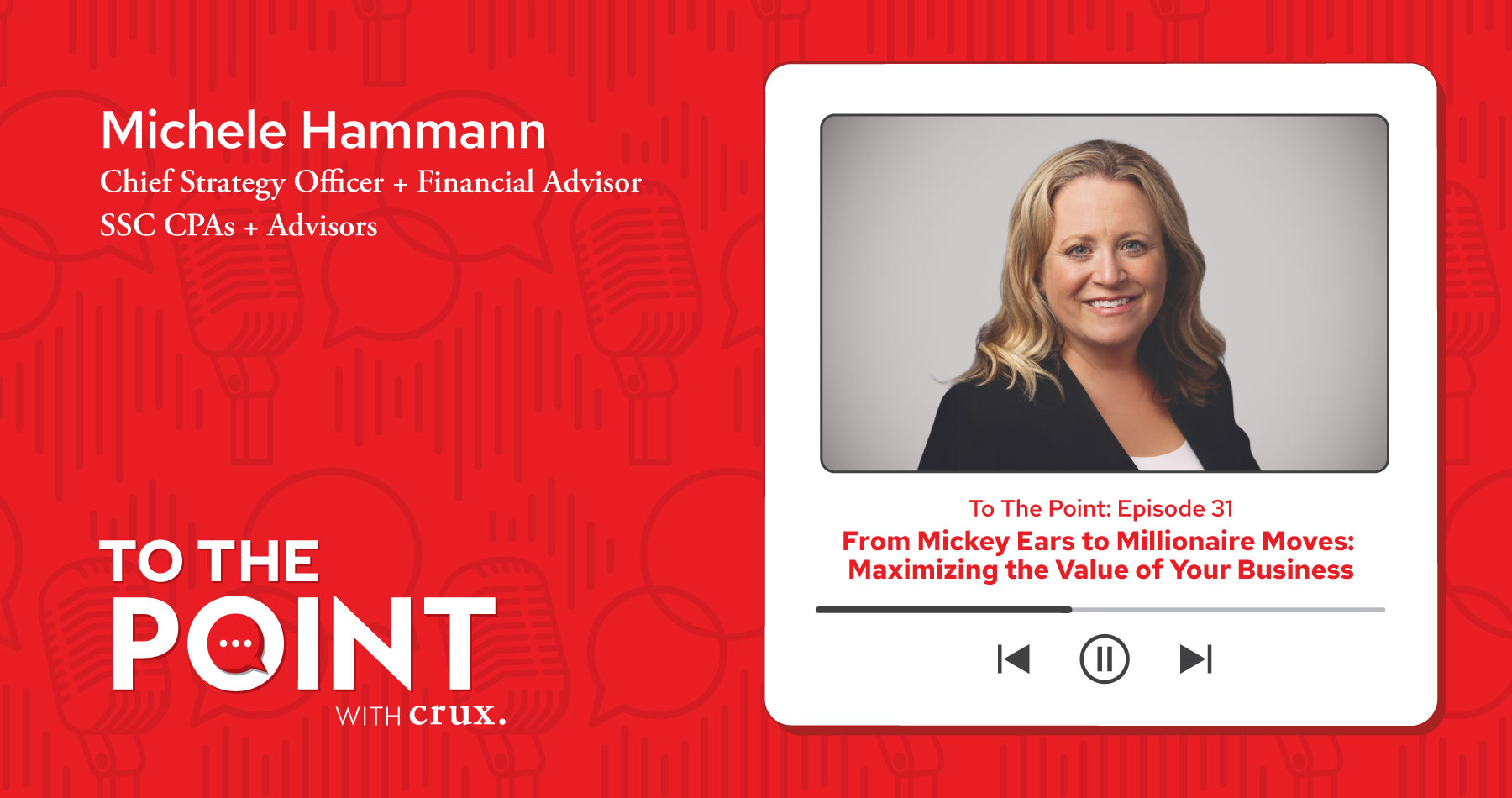
For our 31st episode, President & Chief Strategy Officer Ethan Whitehill chats with Michele Hammann of SSC CPAs + Advisors about rejoining a family business, focusing on financial independence v. retirement, and what business leaders can learn from The Walt Disney Company.
Ethan Whitehill: Hi, everyone. Welcome to our podcast “To The Point”. I’m Ethan Whitehill, President and Chief Strategy Officer of Crux, the “un-agency.” We produce this monthly podcast to bring you thought provoking conversations that get to the Crux of it and help entrepreneurial brands fuel growth. Our guest for episode 31 is Michele Hammann. Michele rejoined SSC CPAs and Advisors in 2005, then SSC Wealth in 2019. She serves her clients through proactive business consulting and financial planning. Michee is also a certified valuation analyst. She received her Master of Accounting and Information Systems in 2001 from the University of Kansas. She’s a member of the American Institute of CPAs, the Kansas Society of CPAs, and the National Association of Certified Valuation Analysts. She is the past chairman of the board of the Lawrence Chamber of Commerce and past President of Junior Achievement of Douglas County. In 2019. Michele received the KS CPA/AICPA Women to Watch Experienced Leader award. That’s awesome.
Michele Hammann: You make me sound kind of impressive there Ethan, but I wouldn’t say that.
Ethan Whitehill: Michele, welcome to the podcast. We’re thrilled to have you.
Michele Hammann: Thanks for having me. I appreciate it a whole bunch.
Ethan Whitehill: So, for those who don’t know, I used a lot of letters.
Michele Hammann: You did.
Ethan Whitehill: What is SSC?
Michele Hammann: Yeah, so SSC CPAs and Advisors. So, we work with business owners who take and connect their personal goals and their business goals, help them increase the value of their business and then help them navigate the complex tax, accounting, and wealth management world. So, we work primarily with business owners to kind of help them maximize the value of their business so they can help reach financial independence and then make sure they’re compliant along the way with all of the tax, payroll and, and financial statement stuff.
Ethan Whitehill: Financial independence sounds good.
Michele Hammann: We use the term financial independence instead of retirement, because we find that for a lot of our business owners retirement isn’t their ultimate goal. They’re going to be doing something different and growing and building probably their whole careers until they’re ready to stop. So, it’s more about financial independence. When do you get to do what you want to do and have reached some of those goals that you’ve set for yourself along the way?
Ethan Whitehill: I always think of retirement as re-wirement.
Michele Hammann: I love that. I love that.
Ethan Whitehill: Because usually, yeah, you’re right. You’re not retiring, you’re just doing something different.
Michele Hammann: You’re just doing something different.
Ethan Whitehill: So, speaking of something different, you came into a family business. And if you noticed when I was talking about your bio, I said rejoined probably because you were there and then you experienced other things and came back. But what’s it like carrying the torch for a family business?
Michele Hammann: Oh my gosh. You know what, the best part is I really feel like I haven’t had to, you know? My dad started the business in ‘84 and I was so blessed to get to work with him and my mom and my brother in the business for many years until he retired. But my dad brought in non-family member partners all along the way. So, there is a great team of people that I get to work alongside with. And so, he continued to grow and build it and make an employee owned for a long-term success and not just a family business. And so, it hasn’t just been me. We’ve all got a candle and not just one big torch.
Ethan Whitehill: Maybe it’s not a biological family, but it’s a family.
Michele Hammann: Oh, we absolutely are. I mean our CEO Brian, he started at the firm as an intern at 19, 20 years old. And now he’s our CEO. So, I’ve known him pretty much our whole lives, which makes him kind of like the brother that you want to kick. No, he is a great business partner and, you know, most of the people at the firm, we have double the average tenure of some other CPA firms, so we spend a lot of time together.
Ethan Whitehill: And that says a lot about your culture, which we’ll get to in a little bit. You mentioned something earlier; you said you’re employee owned. And that’s an ESOP, but you haven’t always been an ESOP. So, talk to us a little bit about that decision and the journey to that employee ownership.
Michele Hammann: Absolutely. We’ve been an ESOP since 1999. My dad, Gary, was on the Kansas State Board of Accountancy when CBIZ was looking to change their structure to allow them to go public and be listed on the New York Stock Exchange. And when they presented how they were changing their structure, we borrowed that. Gary said, “Well we don’t need to be owned by the public, but we could be owned by our employees.” So that was created in 1999. And over time, we’ve been selling in stock into the employee ownership plan, so we’re able to leverage that as a succession planning tool. It’s also a great tool for our employees and our culture.
Ethan Whitehill: So, let’s talk about the culture a little bit. With the ESOP model, how does that change the way people behave within the team in the office? And what is the impact that has for clients?
Michele Hammann: You know, I feel like it’s helped with our retention rate significantly. For our clients on the client service side, they’re not having to retrain and reteach their team members whenever I get somebody new on the account because they have the same people over time. It’s easier for our clients, our team members build even more depth and knowledge of our clients so that we can help them and advise them in a more meaningful way. As it relates to culture, one of the things is that we’re owners of our business and we’re working with business owners, so the ownership culture aligns. We think like owners because we are. So, we hope that we can meet our clients where they’re at, knowing that we’re facing some of the same things and dilemmas and working hard as owners, just like they are. I think it changes our perspective on the client. I think it changes our perspective with each other, we’re all in it together. It’s allowing us to create a bigger vision for everybody in the firm because they’re all participating.
Ethan Whitehill: And I know that experience going through the ESOP yourself and learning from the model. That positions you well to serve other businesses that are looking to transition to ESOP. Talk about that a little.
Michele Hammann: Yeah, absolutely. A lot of people when they’re thinking, “should I be an ESOP?” It’s easy for an advisor to go straight to “Do you have enough cash flow? If you have enough cash flow, you should be an ESOP, right?” No, it’s not that simple. Cash flow matters, employee base matters, but having a good group of middle management, having a good transition plan, and then having a culture that supports employee ownership are all big pieces. It’s easier to do the math than it is to assess culture and fit and all of those things, but it’s just as important. I’ve always felt that we are really good ESOP advisors because we live it every day. We’ve been figuring it out for 26 years, I wouldn’t say we’re a master. There’s different ways to explain it to our team members, to onboard them, to bring them on. We have some other clients that are 100% ESOP owned that I would say have reached mastery. You sit down with them and they say, “Oh my gosh, we have so much more we could do. We have so much more we could do to help with the ESOP culture.” So, we’re always learning and growing, and it’s fun to do it with our clients.
Ethan Whitehill: And as you’re learning and growing, as an advisory, part of your job is to help people run their businesses better. You know, that makes me think, this is an interesting time to run a business. There’s a lot of uncertainty. So how do you help clients navigate that uncertainty and stay resilient even though we don’t always know what’s going to be coming around the corner?
Michele Hammann: You know what, I would say uncertainty isn’t new, you know? There’s always uncertainty, I just feel like now it’s louder, coming at you faster, and testing our resiliency more. How do we help our clients tune out the noise? How do we tune out the noise and stay focused? What we like to spend time as a firm doing and also helping our clients do is planning. We spend a lot of time doing planning and forecasting. Where do they want to be in the next one, two, five years? What are those key things? What are those key value drivers to help them get there and then help them execute on that. So when uncertainty creeps in, when those things creep in, we can go back to the plan, right? The plans aren’t static, the plans change and they need to change, but then we can have a discussion about is this uncertainty or this new thing worth a plan change for? So, I take a lot of comfort in making a plan and seeing how we’re tracking towards the plan, not looking back to what we did last year and comparing how we’re doing today. Because there’s so many excuses. “Well, last year was this, last year was that.” Well, we had a plan to be like this. We had a plan for this revenue growth, for this gross profit, for this net income to buy this location, to do this thing. So how are we tracking to the plan, as opposed to how are we compared to last year?
Ethan Whitehill: How do leading indicators fit into that, too? Because, you know, when I think about tracking the plan and KPIs, a lot of that’s historical. So, to get away from rear view mirror management.
Michele Hammann: You know, if you have rear view mirror management and then financials that take 60 days to get done or closed, you know, or 45 days before you see, if you’re not seeing your March financials until April 30th of the next month, you’ve lost 60 days. Because you weren’t able to course correct in that time period. So, we’ve got so many cool new technologies that can allow for daily reporting so we can get more and better timely financial statements. And then it is taking and marrying those operating things to the financial stuff that makes it so much more powerful. When we cannot just look at days and accounts receivable, but the number of POs are out there, or the number of sales touches that equal an actual sale, we can track sales real time in advance and see where it’s going to end up on the other side. So operational data and financial data smashed together in the right way, I think tells a much better story than any balance sheet and cash flow that you’re going to look at.
Ethan Whitehill: I love that response because, you know, when you think about uncertainty, it’s usually this fear of something that hasn’t manifested yet. And at the same time, you have things at your fingertips that can give you some confidence in where you’re going and the direction.
Michele Hammann: Absolutely. Our business owners know it, and they usually have those things that they’re looking at maybe that we just haven’t operationalized to be able to look look at, you know? And they have things in their head that we just need to get on paper, or out of the manufacturing shop, or out of sales and get something together that can help them see trends, their trends, and not what other people are telling them is happening.
Ethan Whitehill: I like that plan. So, I’m going to change gears a bit. Yeah. Kind of getting out of the business, I know you take your role as a leader seriously. Again, going back to your resume, you’ve had a lot of leadership roles in your career and you’ve mentioned that you had an opportunity to attend the Disney Institute for Leadership. I know you’re a little bit of a Disney fan as a result of all of this. What was it about that experience and how has that impacted you personally and professionally?
Michele Hammann: I appreciated that you used the word fan and not fanatic––my husband would say crazy. But, it was such an opportunity. I got to do that at the end of my internship at Price Waterhouse. They would send all of the interns to the Disney Institute for a week. It was such a blessing to get to see business done the Disney way. And so, you know, it was really twofold. The first is the focus on client experience that Disney does like no other. It’s all of the little things that Disney does that adds up to an incredible client experience. Have you ever noticed at Disney, they don’t point with one finger and tell you to go over there. They will point with two fingers or an open hand if they are unable to walk you somewhere. They’ve studied that that is the best experience for a guest so that they’re getting the Disney way. Right? Their brand and how they protect their brand and all the things that they do to make sure that the characters stay whole and complete and wholesome and complete. You never see Mickey around the side corner with his head off smoking a cigarette or taking a smoke break, right? The protection of the brand and the client experience, it’s like no other. In order to get that kind of branded protection and increase the client experience, you have to cast a vision so big so that they can take it in and make it their own. You really have to be able to cast a vision and lead people to provide that level of experience and make it just part of who they are. So, I’m a big Disney fan, in fact I’ll be there in June.
Ethan Whitehill: That makes me wonder, do you have a no pointing rule at SSC?
Michele Hammann: So, you know, one of our key values is to be clear. Accountants take a lot of value out of being the smartest person in the room, and I firmly believe that it doesn’t matter how smart you are if nobody knows what you’re talking about. So, we shepherd our clients, maybe not with pointing, but with language that is clear and also meets our clients at the level that they’re at. So that’d be our version of the Disney point. It doesn’t matter how much we know of our clients, we know how much we care. And I think that our clients really appreciate the way that we talk about financials, how we talk about wealth management and how we talk about financial independence so that it aligns with what they’re thinking.
Ethan Whitehill: I have to ask now, do you have mouse ears?
Michele Hammann: Oh, so many pairs, Ethan. That’s so funny. I just saw this new way to display them where I could put them in like a little (case), they’ve got so many options now.
Ethan Whitehill: Well, that was maybe a little bit of an uncertain question that I asked you. But I’m going to take you down the rabbit hole, or the mystery mountain. What’s a Disney reference here for my 20 questions? I’ve got my 20-sided die and I’m going to roll that and we’ll see whatever comes up. Ooh, I don’t think I’ve ever rolled a one. This one might tie back to what you were just talking about. What’s a smell that instantly takes you back to childhood?
Michele Hammann: Childhood? Wow. That’s a really good question. Anytime that I’m on a golf course in spring, that kind of wet dewy grass smell, whenever I smell that it reminds me of playing golf with my family and my friends. It’s just one of those smells that can hit.
Ethan Whitehill: Grass is definitely a powerful memory smell.
Michele Hammann: And you can get it a lot, but there’s a difference. Fresh cut grass, dewy morning, 7:00 a.m. tee time, it hits different.
Ethan Whitehill: I worked at a golf course over a summer in high school and I know that smell well.
Michele Hammann: It just feels good. The Disney smells, they’re big into that too. At EPCOT, on the ride “Soarin’(Around the World),” you’re sitting there and they take you over all the different places in Florida. You go over one place, and it smells like orange groves. You go over another and it hits you with the pine smell. So, for Mother’s Day last year, my daughter got me a bunch of little different Disney smells. I know it’s ridiculous, but it’s so brilliant.
Ethan Whitehill: Well, Michele, this has been a blast talking to you. How can listeners connect with you personally? And how can they learn more about SSC?
Michele Hammann: Absolutely. Come check out our new Crux-done website, ssccpas.com. My LinkedIn is on there and if you find me, I’d be happy to talk about anything. Drop me a note and I’d love to talk to you, especially ESOPs.
Ethan Whitehill: I appreciate that. Thank you very much.