Measure What Matters: Leveraging Data to Define Marketing Success
It’s no secret that data and analytics are essential to any business – especially in todayR...

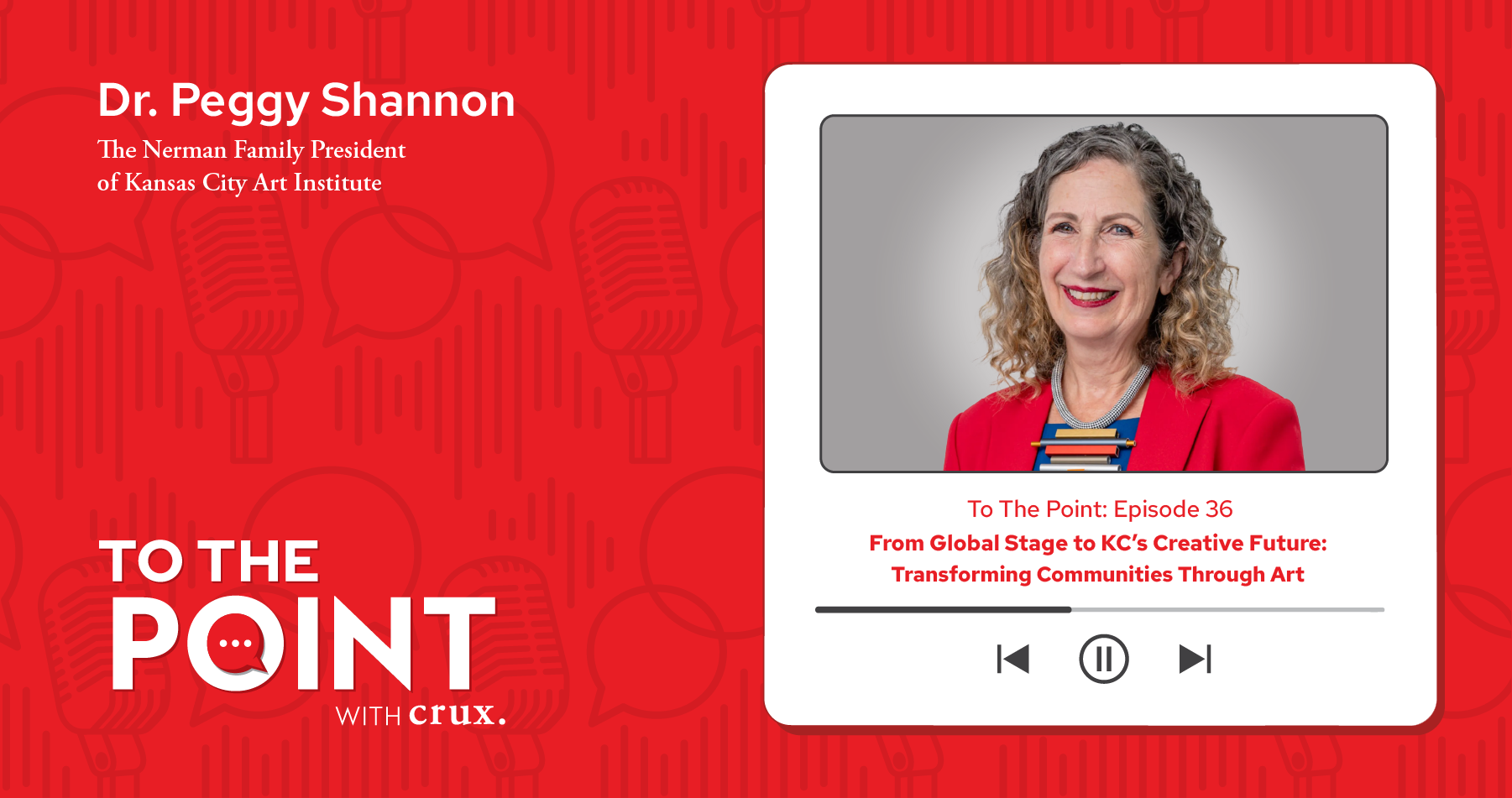
In Episode 36 of To the Point, Ethan Whitehill sits down with Dr. Peggy Shannon, president of the Kansas City Art Institute, to explore how KCAI equips students for success in a changing world, and why art education fuels cultural and economic growth in Kansas City and beyond.
Ethan Whitehill: Hi everyone. Welcome to our podcast To the Point. I’m Ethan Whitehill, President and Chief Strategy Officer of Crux, the “un-agency.” We produce this monthly podcast to bring you thought‑provoking conversations that get to the crux of it and help entrepreneurial brands fuel growth. Our guest for Episode 36 is Dr. Peggy Shannon, the 26th Nerman Family President of the Kansas City Art Institute.
Over the past two and a half decades, Dr. Shannon has served as a tenured professor of theater and as a university administrator at colleges including UC Davis, San Diego State University, Toronto Metropolitan University, and the Nova Scotia College of Art and Design—all before joining the Kansas City Art Institute in May of 2025. She is also a recipient of the King Charles III Coronation Medal, Dr. Shannon holds a PhD in drama from Royal Holloway, University of London; a Master of Fine Arts in Theater from the University of Washington, Seattle; and a bachelor’s degree with honors in theater from the University of California, Riverside. Peggy, it is an honor to have you on the podcast.
Dr. Peggy Shannon: Thank you for the invitation to be here today.
Ethan Whitehill: Well, you have such an impressive career journey, as I just described, through the arts and higher education. How did you find Kansas City, and what surprised you most when you got here?
Dr. Peggy Shannon: First of all, I’m very happy to be here with you today—what a great start to my day. Kansas City was a city I had heard about for a long time. I grew up in California, I’ve traveled a lot, but I had never lived in this part of the country. My mother was from Ohio and my father from Oklahoma, so when I first arrived in Kansas City as a job candidate, I felt like I had come home. It was like speaking with people I recognized.
I find Kansas City vibrant and full of art, which honestly surprised me—the number of art collectors, galleries, museums… it was pretty amazing. The city is beautiful, I love the seasons, and the people have been incredibly welcoming.
Ethan Whitehill: And you didn’t even mention the barbecue.
Dr. Peggy Shannon: Well, I’m a big meat eater, so the barbecue is definitely a draw for me. My husband is vegan, so that was interesting—but he’s a sports fan, so he got the Chiefs, and I got the barbecue. Together, we’re very happy in this city.
Ethan Whitehill: You’re coming here with wonderful global perspective, and you’ve clearly been immersed in the Kansas City culture. As we think about the Art Institute, your appointment represents an exciting new chapter for the institute. What is your vision for KCAI?
Dr. Peggy Shannon: I’ll back up a bit, because it’s not just my vision—it’s the institution’s vision, which I believe is why they hired me. About a year before I began, in summer 2024, the board launched a new strategic plan. Along with that plan, they hired a master planning firm and a landscape planning firm. I walked in a year into that process.
My goal is to activate the plan—to work with the planners who are shaping a new vision for the next 50 years of the Art Institute. I want to grow our brand, build a stronger gateway to our alumni locally, nationally, and internationally, and activate our community of creatives. And I want to ensure we remain current in everything we do.
Ethan Whitehill: It’s funny—when I think of higher education and long‑term planning, hearing someone say “50 years out” is surprising. In business, we’re usually thinking three, maybe five years out if we’re lucky.
Dr. Peggy Shannon: Right. The strategic plan is a five‑year plan, but the master plan involves rethinking our assets. We currently sit on 18 acres and may expand that footprint. When you start talking about building projects, you’re thinking 50 years out—not three to five.
Ethan Whitehill: So considering that timeline and KCAI’s significance in Kansas City, talk a bit about how the Institute impacts the city’s cultural and economic fabric.
Dr. Peggy Shannon: This has been another big surprise. Seven and a half months into my job, I’ve been meeting cultural, educational, business, and industry leaders. Nearly every person I meet has either hired one of our graduates, employs alumni, or is an alum themselves.
KCAI’s impact on Kansas City and beyond is huge. People really see it as a jewel in the city’s crown. And we’re different—we’re educating the next generation of creatives. Our impact is visible everywhere I go.
Ethan Whitehill: I see that all the time, especially in our industry. Many working artists who’ve transitioned to the commercial side have worked with us. That brings me to my next question: the world of work has changed. Workforce needs have changed. Dare I mention AI—and what that impact looks like. How does KCAI prepare students for employability and professional practice?
Dr. Peggy Shannon: Workforce alignment for creative people is something I care deeply about and have prioritized in past roles. We have a program called Professional Practice, where we partner with alumni and businesses so students can be mentored or work alongside professionals.
We also have Sponsored Studios—companies can hire KCAI, and our students take a class that produces a mural or other project for them. This builds industry networks and gives students real‑world experience.
Starting next year, we’re introducing mandatory courses that teach practical skills—how to write a résumé or CV, how to build a compelling portfolio, that sort of thing. And we have an entrepreneurship minor offered in partnership with UMKC’s Bloch School. Ultimately, we want our students to work when they graduate—whether in industry or in their own studio practice. They need to know how to work.
Ethan Whitehill: We work with other higher‑ed institutions too—not necessarily art institutes—and the ROI of education has become a top priority. Parents and future students really focus on that.
Dr. Peggy Shannon: Absolutely. Education is expensive, and students often leave with debt. It feels unethical to me not to prepare them to support themselves after four years. So, we focus heavily on that.
Ethan Whitehill: For those who don’t know, can you give some context about the scale and scope of KCAI?
Dr. Peggy Shannon: Sure. We sit on 16 acres and own 19 buildings. We have a strong financial endowment, and about 64–65% of our budget comes from tuition. The rest comes from endowment drawdowns and fundraising. We have 13 majors, with illustration, animation, and painting among the most popular.
People are often surprised at our small faculty‑to‑student ratio—10 to 1 on average. We’re very studio‑focused, with hands‑on, experiential learning at the center of what we do.
Ethan Whitehill: We’ve talked about KCAI’s impact on Kansas City and on students entering the workforce. What are some notable alumni stories that highlight that ripple effect—those who’ve really put their skills to work?
Dr. Peggy Shannon: Recently I was in Los Angeles and hosted an alumni donor dinner in Santa Monica. Paul Briggs, one of our alumni, joined us. He worked for Disney for 20 years and now works for Netflix. He has also visited campus to speak with students.
But beyond being proud of Paul, I want him engaged in what we’re doing—how can we send students to him? How can we bring him back to campus?
I’ve been mapping where our alumni are—Philadelphia, Chicago, New York, and many more. We also had Keith Kirkland, not an alum but a fellow, who creates wearable art for people who are visually impaired. His innovations can help museums, galleries, airlines, and even the auto industry. He’s now back in New York continuing his practice. I’d love to create a small hub there so students can spend a semester working with him.
Ethan Whitehill: I love the innovation that comes out of the arts. That’s a great example. Switching gears a bit: what role does development play in the institution’s overall growth?
Dr. Peggy Shannon: It’s critical. We rely on donors for a percentage of our operating budget. Donors are interested in the Art Institute for many reasons: some are alumni, some are parents of alumni, and some come from families that have always been on board. Others are art collectors or are simply invested in the next generation of creative talent.
Our donors and board members work closely together, though often for different motivations.
Ethan Whitehill: In a previous conversation you called creativity “essential.” How does creativity shape the way we understand and change the world?
Dr. Peggy Shannon: Every waking moment—for those who can see, hear, or smell—we’re influenced by creativity. How we dress, what kind of car we buy, how we decorate our homes, what we choose for our work environment… all of these reflect creative choices. Even the greeting cards we pick out at the holidays.
Creativity shapes how we use technology, how we think about color, line, form, and weight. These are creative decisions we make all day long.
Ethan Whitehill: That’s well put.
Dr. Peggy Shannon: And many people don’t realize they’re creative—they don’t think about it.
Ethan Whitehill: So what advice would you give to people who don’t see themselves as artists but are interested in creativity and innovation?
Dr. Peggy Shannon: When you’re outside walking down the street, really look at the trees, the colors, the natural beauty around you. That’s a good start.
If you’re in a store and feel a little down, look at the color of the walls—ask yourself if that’s affecting your mood. If you’re in a waiting room and something makes you feel good, ask why.
Be aware. Be present. Notice the people near you, the walls, the floor, your clothing. Just be aware. That awareness is how creativity enters your consciousness, even if you weren’t thinking about it before.
Ethan Whitehill: Someone once told me: “Anyone who tries to improve the world is a designer.”
Dr. Peggy Shannon: That’s so true.
Ethan Whitehill: It’s usability. It’s everything.
Dr. Peggy Shannon: Exactly. And my husband gets tired of me saying, “I just like clean lines.” He says he doesn’t even know what that means. And I say, “Well, look at this—and then look at that. These are clean. That’s a little messy.”
Ethan Whitehill: Speaking of messy—we’re at my mystery question.
Dr. Peggy Shannon: Okay—the mystery question.
Ethan Whitehill: I’ve got my 20‑sided die. Whatever number comes up is what I’ll ask. What’s your guilty‑pleasure TV show?
Dr. Peggy Shannon: Oh, that one’s easy—BritBox, and pretty much any crime drama with lots of seasons. As a theater director, I love stories that unfold across multiple seasons. British crime dramas—I’m a total addict.
Ethan Whitehill: They’re definitely brighter than the Scandinavian ones—those get really dark.
Dr. Peggy Shannon: They do! Very dark and very interesting. But not my guilty pleasure.
Ethan Whitehill: On the British side, we watch The Great British Bake Off. We’ve watched an obscene amount of it.
Dr. Peggy Shannon: So good.
Ethan Whitehill: So good. And they’re all designers—artists doing their thing. It’s cool to see their process and how they evolve over a season.
Dr. Peggy Shannon: It’s fascinating. I love that show too.
Ethan Whitehill: Peggy, how can listeners connect with you or learn more about KCAI?
Dr. Peggy Shannon: Email me at president@kcai.edu, or visit our website, the Kansas City Art Institute. I’m always happy to welcome visitors, give tours, and introduce people to the Institute.
Ethan Whitehill: Thank you for this conversation. You’ve inspired me to go for a walk over lunch.
Dr. Peggy Shannon: Look at the leaves—almost gone!
Ethan Whitehill: A little tree bathing, maybe.
Dr. Peggy Shannon: Yes! It’s called “earthing.” Apparently it’s big in California. Take your shoes off, feel the ground.
Ethan Whitehill: I love it. Thank you so much.
Dr. Peggy Shannon: My pleasure. Thank you.