Crux-Xcelerate pivots with key hire, fueling growth for local businesses through six-month sales curriculum
PRESS RELEASE For Immediate Release Kansas City, Mo. – In most organizations, sales and marketing cl...

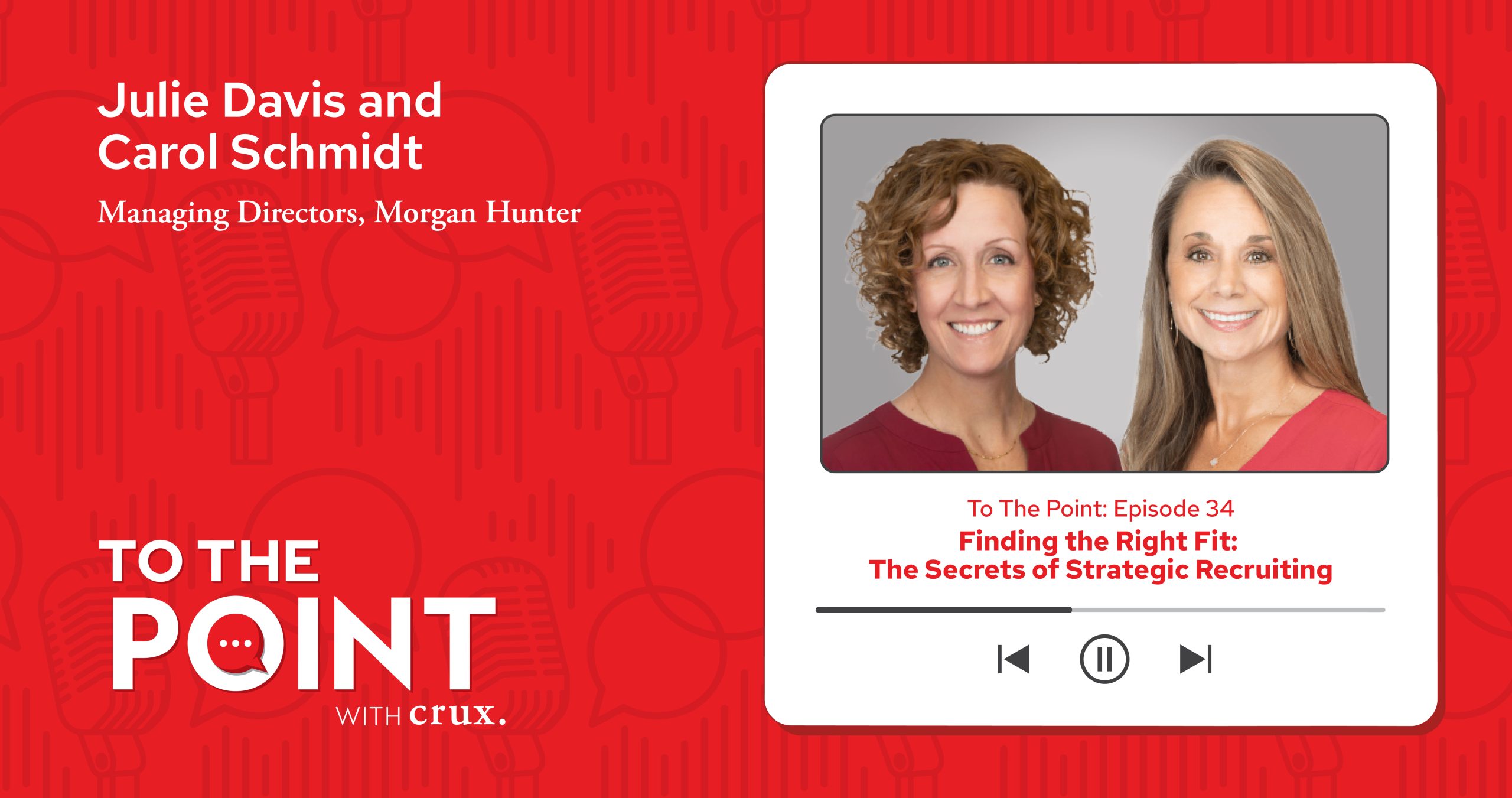
For our 34th episode, President & Chief Strategy Officer Ethan Whitehill chats with Julie Davis and Carol Schmidt of Morgan Hunter about building lasting partnerships, listening to understand, and recruiting in the age of automation
Ethan Whitehill: Hi everyone. I’m Ethan Whitehill, resident and chief strategy officer at Crux, the “un-agency.” Welcome to episode number 34 of To the Point. We produce this monthly podcast to bring you thought provoking conversations that get to the crux of it and help entrepreneurial brands fuel growth. Today’s guests are Julie Davis and Carol Schmidt, managing directors at Morgan Hunter. Since 1986, Morgan Hunter has helped Kansas City area employers meet a range of hiring needs from temporary staffing to direct hire placements. The company is composed of three key business units: Morgan Hunter corporate specializing in placements for accounting and finance, administrative HR IT and sales and marketing; Morgan Hunter Education, which partners with local school districts to provide qualified, professional substitute teachers throughout the KC metro and surrounding counties; and Morgan Hunter Healthcare, supporting healthcare and IT needs nationwide, thoughtful, and thorough in their approach. The firm is committed to creating a tailored hiring experience for both the employer and job seeker, believing everyone deserves to find the right fit. Julie and Carol, welcome to the pot. Thank
Julie Davis: Thank you. It’s an honor to be here. We’re excited.
Ethan Whitehill: I’m going to start with this and maybe Julie, you want to take this one, but Morgan Hunter has been in business for nearly 40 years, a very impressive milestone for the company. Talk to us a little bit about the history.
Julie Davis: Yes, excited to talk about that. So, we were established in 1986. Jerry Hellebusch, who’s our owner, opened the doors in Overland Park and he started with the accounting and finance division as well as the administrative. And Jerry by trade was doing accounting placement. That’s where he learned the business and then soon, he added the IT division and then human resources and sales and marketing operations and we’re all divisions kind of staying in our lane. And then in 2002 he launched Morgan Hunter Healthcare, which provides consulting to healthcare organizations. So, working with different EMR systems. And then in 2007 with Carol’s idea of establishing our Morgan Hunter education division, we provide substitute teachers within 13 school districts in Kansas and Missouri. One of the things that sets us apart is we’re one of the oldest privately held staffing firms in Kansas City. And we do stay local, which is what we’re really proud of.
Ethan Whitehill: And as I understand it, that longevity of the company also extends to the workforce at Morgan Hunter. Now you have a really great culture that has made that sustainable. Tell us a little bit more about how that works.
Julie Davis: Yes. I would say we’re in the people business, so we have to take care of our own people. And so, our average tenure at Morgan Hunter’s 12-and-a-half years. We have five employees over 25 years which is pretty remarkable because I think the average tenure is three years now, and I think we’ve done a really good job meeting our employees where they are in their stage of life. For Carol and I–24 years ago–we started our job share and this allowed us to stay in our roles, grow in our roles, but then also be there for our kids’ school activities, volunteer at our schools, be present in their lives. But it was great because we could constantly know our clients and our candidates are being taken care of by having the job share. We’ve also have supported our education division. We have two employees that do a sabbatical in the summer, so they take the month of June off because there’s no school in session. So, they can focus on their families. And then as our employees are getting near retirement, there’s two employees that take off in the winter months. They go down to Florida and Georgia set up a temporary office and work from there.
Ethan Whitehill: That’s amazing. So, I have to go a little deeper on that, but how do those conversations begin? Like was that a plan or was it really just adapting to, “hey, we have an employee who has this need and we’re going to be flexible and work with them?”
Carol Schmidt: I think it was more adapting. Like Julie mentioned earlier, we’re in the people business. So, I think that’s one of the things that we work on the most is to make sure that our people are taken care of, and we meet them where they are at that point in time in their life. So, I think it’s the relationships we have with them and there’s understanding of what’s going on in their life. Luckily with technology you can work just about anywhere and we’ve embraced that and really helped retain our staff.
Ethan Whitehill: That’s such a great approach. I appreciate that. So, I’m going to shift gears and just to back up a little bit for those who are curious, you know, when should a business even leverage a recruiting firm? So, when should they be thinking about Morgan Hunter and you know, what are the benefits of that partnership?
Carol Schmidt: I think people think they know what recruiting firms do, but sometimes they’re not quite sure how to approach one. But usually we work with companies who, maybe they don’t have a recruiting team, but then we also work with companies who have a recruiting team and then we’re an extension of that recruiting team. A lot of times what we work on are hard-to-fill positions. Maybe a company is struggling to find the talent that they’re looking for. So, in those cases what we’ll do is help find the talent that they’re looking for. Also, if there’s an urgent hiring need–if an employee resigns unexpectedly–what we’ll do is help fill that role because there’s the need for speed to find the right person. And then sometimes a business is picked up rapidly and they need to ramp up quickly. We help them in those regards.
We also do confidential searches. I think that’s a lot of things people don’t think about. It could be for a variety of reasons. It could be an underperforming employee that needs to be replaced. If you need to keep the higher confidential, maybe you don’t want to signal change to your employees. So, you would utilize us in those situations. Or if you don’t want the competitors to know or just the general market industry knowledge, it’s a lot easier to use a third-party recruiting firm like us to have a confidential search. And then you don’t have to advertise out in the market. We also can attract passive talent. Really, when you have a job opening and you post it, you’re at the mercy of who happens to be looking for a job at that time. And there’s not always that right person looking for your job at the time that you need that person.
So, you’re missing out on hidden talent if you’re just posting your position and not working with a recruiting firm. And then we also build relationships with candidates, so we understand what they want in their career, what that next step looks like for them. So, we’re able to reach out and connect with them–that passive talent–when that right job comes along that we know that’s what they’re looking for. So they’ll have that conversation when we introduce the individual to the company as opposed to when they wouldn’t be out there applying through the mainstreams of job postings. We conduct the interviews, so we do the screening and interviewing for a company and then we save time and money because you don’t have to dig through the resumes looking for applicants who probably are not going to be qualified for what you’re looking for. So, we make sure that they’re qualified, that they’re interested in the job.
And then also that they meet the salary range for the position that you’re posting for, too. Another thing that people don’t think about is contract, temporary employment. A lot of times if you have special projects that maybe your current staff can’t handle, we would have contract employees available to fill in. Also leaves–medical leaves, maternity leaves–we see a lot of those with our clients to help in that interim when people are going to be out for extended leaves. And then sometimes just not the ability to add to head count. Maybe that’s not a position that you can get added to the budget, but you can bring in a contractor to get the work done in the meantime. So, both direct hire and contract are the two areas that we can help a company.
Ethan Whitehill: Sounds like you guys are busy. There’s a lot of things that you’re doing and I really love the concept of that confidential search because it’s amazing to me how people watch those job postings. You know, and they know and there’s questions when, when those are posted and I think that’s a nice resource to have a partner who can do that. And also the passive approach that you mentioned because you know, timing is everything and that’s one of the hardest things in the market today is just getting the right person at the right time and having everybody’s schedules align where it works. So, it’s a really cool opportunity. Speaking of that and kind of talking a little bit about the job market today, how is the in Kansas City the same or different than the rest of the country? You’ve got some national perspective with what you do, so I’d be curious what that looks like.
Julie Davis: The Kansas City market’s strong in certain sectors. Definitely going crazy strong in commercial construction. You know, manufacturing, we’ve got the new Panasonic plant that’s hiring like crazy. Data centers, that’s going to be a big, big push in our market. But there are certain areas that are cooling down and that’s the IT market. I think for the most part, from the candidate’s perspective on the market, it’s taking longer. Landing a job today is more difficult than even a year ago, six months ago. Companies are back in the driver’s seat, used to be the candidate’s market, now it’s the company market and there’s just, I think, a lot more steps for the candidates, a lot more interviews that they’re having to go through, a lot more assessments. So, the time, the process is a lot longer from the candidate’s perspective,
Ethan Whitehill: Noting that it is a company market versus market, what are candidates looking for in an employer today? So, if we kind of flip it and think about how you’re helping them with those right fits–how is it different for younger generations versus maybe the previous generation of workforce?
Carol Schmidt: I think candidates overall are looking for flexibility. And flexibility means different things to different people. Whether it be a traditional hybrid schedule or just not that hardcore rigid eight to five at your desk, not a lot of people want that anymore. I think since the pandemic a lot changed with norms around the office settings and that thirst for flexibility has not changed. People still want meaningful work, they want to feel appreciated at work, a good company culture, but flexibility still tops the list of what candidates are looking for in a new opportunity. With the generation entering the workforce, one thing that we have really noticed, they’re not afraid to ask for and to negotiate for job offers.
We oftentimes hear of college grads negotiating the job offer when they get it. Now whether they’re coached from professors, we’re not sure where that comes from, but they’re not afraid to ask, which is kind of refreshing to see that confidence coming into the work world. Most of the younger generation, they are looking for career growth and skill development, but it’s not necessarily the old-fashioned climb the corporate ladder. That’s not what all the younger generation’s looking for. They like to learn new things, try different positions. We’ve heard a lot of research that they’re going to have different careers, not just different jobs, but different careers up to five different in their work time. So, that’s going to be a lot of flexibility and a lot of learning. They still want want to have purpose to align their values and they look for environments that are inclusive and authentic cultures. They also enjoy project work, which a lot of the younger generation will have a side hustle. Maybe if the job that they’re doing isn’t what they’re passionate about, they’ll have a side hustle. That’s their passion. We often hear that time off’s very important to them too as far as they work to live, not live to work. So just having that flexibility for some time off and to do the things that they’re passionate about is important to the younger generation.
Ethan Whitehill: Yeah, that’s really good insight. I want to go back to something Julie said about the IT market cooling. Thinking about AI, because I know that’s a little bit behind that whole trend, it’s happening in a lot of industries. How do you see AI impacting staffing and recruiting today?
Julie Davis: It is changing it so fast, so fast, so rapid. I think for the employers it can make the process a lot faster, more efficient. For example, matching a candidate’s resume to a job description. You know, companies are using that AI for that as well as creating those interview questions. I know for hiring managers they don’t like to interview but like what kind of questions? They’ll throw it in AI and boom, they’ve got a long list of questions. And, of course, we all love using AI for writing, for writing those job descriptions. It’s been a great tool. Corporate recruiters are actually conducting interviews through teams and it’s being recorded, downloaded into their ATS system. So that’s making things a lot faster. But I do think there’s some challenges coming with AI and that’s creating unfair practices. AI is learning the type of candidate, your initial candidate that you’re looking for and it’s going to keep sending you that type of candidate.
So, you have this bias coming through. And so, I think that’s been where companies are really having to watch out for as far as screening. It really creates that lack of human touch. Candidates are becoming less interested because of that. And I do think from the candidate standpoint, you know, they’re getting sent jobs based on their profiles through LinkedIn and they’re doing the applications. But I think it’s becoming very challenging because when they’re sending their application or applying to a job, it’s kind of a black hole and they’re getting rejections for no good reasons. They’re getting sent an email rejection at 2:00 a.m. so you know that there’s that lack of human eye and that human interaction what’s creating.
Ethan Whitehill: So those text messages I get randomly about these amazing opportunities. That’s just ai?
Julie Davis: I think it’s ai. Yes.
Ethan Whitehill: How did they find me? Carol, you mentioned something before we were recording about really what I would call the art of listening. Share a little bit about that because I thought that was really interesting in terms of your approach.
Carol Schmidt: Julie and I were joking about how this is different for us to do a podcast versus what we do on a day-to-day basis because we do so much listening. You know, we interview people and we ask them questions, but we’re really intently listening to hear what they’re saying, what’s important to them. We’re evaluating their skillset and so we do a lot of active listening when we’re doing those. And then on the flip side, when we’re talking to a company or a client to understand the job search we’re going to conduct with them, we’re also very much listening what’s important to them. And so being here, it’s a little bit different because it wouldn’t be a very good podcast if we just sat here and listened. But even sometimes when we go out to take our clients to lunch, we find ourselves doing much more listening than talking.
We’re usually done with lunch before they are, because they’ve done so much talking and we’ve done so much listening. But that’s what we enjoy. She and I, we still get a huge high off of making placements when even doing that all these years, when we make that right match, we have many people who come back to us 18 or 20 years later, and they’re either still in the same job or they say, “that job you got me started my career.” So, at the end of the day, that’s where we still get our high from this work is those people who have found meaningful work and kind of set their career in the direction that they wanted to go.
Ethan Whitehill: Well that listening speaks volumes about the care you put into your work and the attention you give your clients. So, I appreciate that. So, going back a little bit to the history of Morgan Hunter and then looking forward, you’ve been on a successful growth trajectory for quite some time, and I’d love to know, what do you attribute that growth to?
Carol Schmidt: Well, I think a lot of it is the relationships that we’ve built over the 39 years being in business, which it’s really hard to believe that Julie and I have been a part of that for almost 30 years. We joke that we started an internship program when we were in middle school to be, to be the age we are doing this. But I think we have long-term relationships with companies. We understand their company culture, which is huge and with the talent that they need to remain successful. And we’ve built trust with those companies. I know a lot of times when we’re talking with an employer that we’ve worked with over the years, I immediately start thinking of people that I’ve interviewed that would want a job like that. So, I think a lot of it just comes through our longevity and how long we’ve done this and just working with the different companies that we work with.
And then we listen to understand. We truly listen to their needs. Most of our conversations, we do more listening, we do talking. So really trying to understand what they’re looking for, what’s going to fit within their team, what’s important to them and their hiring. And then we often hear feedback from our clients that our candidates are a better caliber than the candidates they’ve interviewed through their own avenues. So really, I think it just comes to our performance when we find the right candidate for the job, that’s why people come back because we deliver on what we say we’re going to do with the candidate side, we get a lot of referrals. We do treat people right through the process. We try to give them feedback, we try to help them, we do interview people that we aren’t able to place, but we try to give them some resources to go out and find the job that they’re looking for.
We can’t give away all of our secrets on where we find candidates, but we do get a lot of referrals and you know, I think doing business the right ways, why people keep coming back to us. And many of our clients might move to a new company and we often follow them to wherever they go. They continue to utilize us even when they take a new position at a new company. And then we do a lot of networking. We have different professional organizations that we’re a part of that we network with and work with. And then we do the old-fashioned cold calling, which is harder to do with people not answering the phone. But we do still do that. And then Crux has been a huge help to us in our social media presence and just creating marketing materials and helping us stay ahead of changes in advertising because that seems like that’s always, you know Just to get people’s attention. There’s so much noise out there is how do you break through that noise to get the attention of the audience that you’re trying to capture and then really just continue with the relationships that we develop.
Ethan Whitehill: Yeah, it’s that what you’re describing to me is kind of that inside out branding. You start with that great culture, you then deliver trust and performance and all these other things and you’ve got your customers talking about you, which is the best form of media really–that word of mouth. What have you learned about brand building over the years that others could maybe learn from?
Julie Davis: Like was mentioned, building that brand on trust. I think that’s probably the most important with the relationships we’ve done. Unlike national firms, we are locally owned, we’re solely serving the Kansas City market. That local commitment has allowed us to understand the market better and building that lasting partnership with our company, our clients, and our candidates. One of the things that makes us unique is we developed specialized divisions in accounting and finance, HR, administrative, IT, and we really stay in our lane. We’re not going to take a job that just to do everything for everyone. We really stay focused so we understand that level of talent and expertise. So, I think that’s really what’s built a lot of our brand. And then I think lastly is our consistency. We have a team with a lot of long tenure, we’ve talked about that. So, when companies work with Morgan Hunter, they’re working with the same consultant and year after year that stability, along with the active involvement in the local organizations and community events has really solidified us in our standing in Kansas City. And I know Carol mentioned Crux, I know we would not be branded like we are today if it wasn’t for Crux. It’s been a seven year relationship, I think back in 2018. And working with Christina Hager now, she is amazing and comes up with such amazing ideas. So, if it wasn’t for her, I know we wouldn’t be out there.
Ethan Whitehill: Well I know she loves working with your team and so thank you for that. Now I’m going to thank you by asking you a mystery question. And I promise it’s not going to be tough. I’ve got my 20-sided die, I’m going to roll it. Whatever comes up is what I’m going to ask. And I’m going to give you a choice. Do you want to answer the same question or do you want to answer different questions?
Carol Schmidt: Let’s do different questions.
Julie Davis: Yeah.
Ethan Whitehill: Okay. All right, here we go. Let’s start with Julie. Okay, Julie, you got a seven. If you could cameo in any TV show, what would it be?
Julie Davis: I think it’d be Friends.
Ethan Whitehill: Oh, nice.
Julie Davis: Yeah, just always being around people and bringing the energy and the laughter. I think that’s what I would do.
Ethan Whitehill: Getting your coffee at Central Perk.
Julie Davis: Yeah, absolutely. Absolutely.
Ethan Whitehill: Awesome. Carol, your turn? Six, what is six? If you could save one material thing from a fire, what would you save?
Carol Schmidt: One material thing. Well, we still have pictures that are not digitized, so I would say the pictures that are not digital because I would hate to lose those.
Ethan Whitehill: Yeah, I love that. Great answer. Well, thank you both. If folks want to learn more about Morgan Hunter, where can they find you?
Carol Schmidt: Well, we are incredibly active on LinkedIn, so LinkedIn is always a good way to reach out to us, message us, connect with us there. Our website, we have a contact us page. You’re welcome to complete that or always call. We are always happy to have a conversation.
Ethan Whitehill: Julie and Carol, thank you for joining the show.
Carol Schmidt: Thank you.