Measure What Matters: Leveraging Data to Define Marketing Success
It’s no secret that data and analytics are essential to any business – especially in todayR...

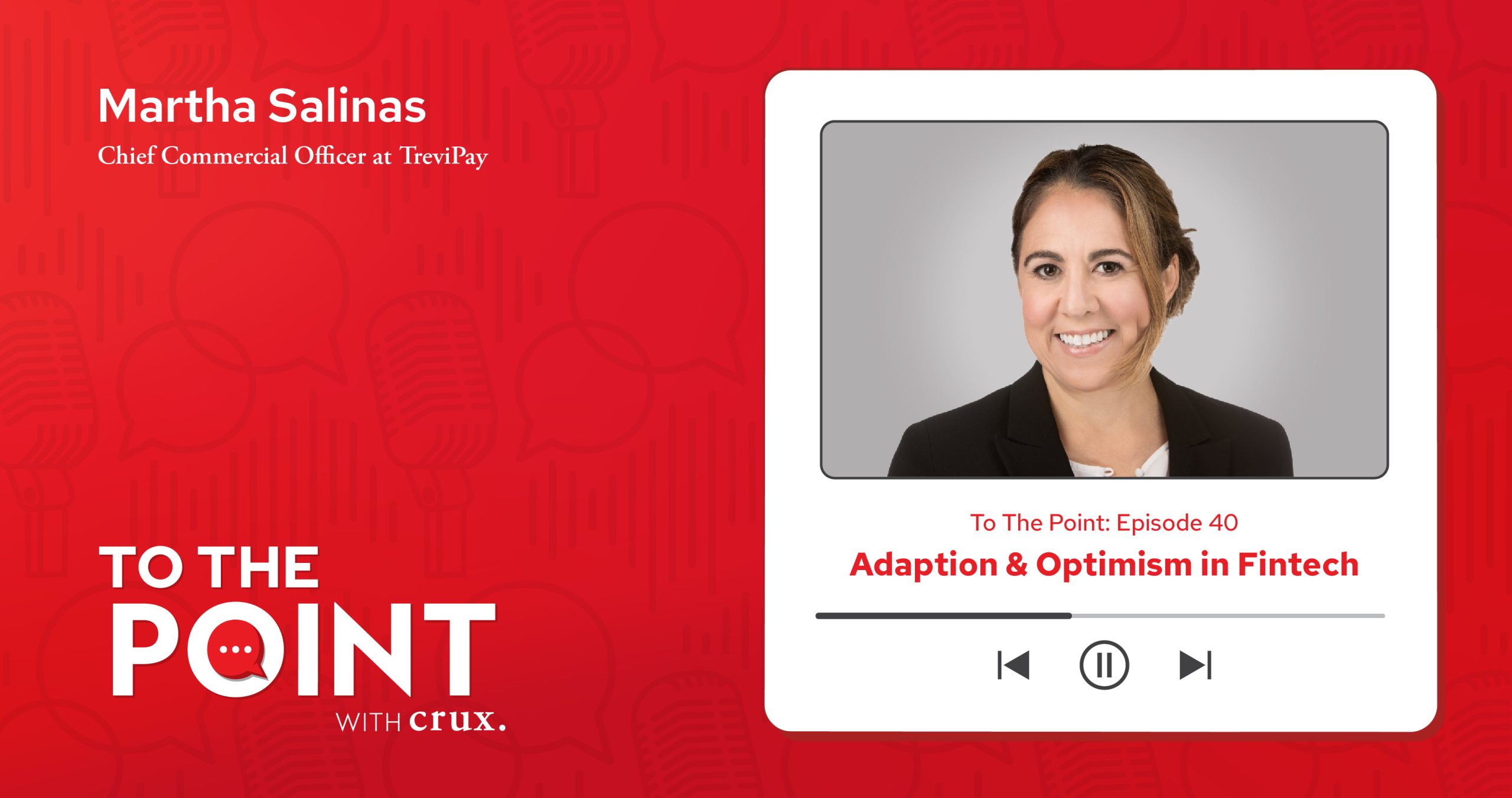
How can a technology company change to meet the rapidly evolving needs of its customers? On the latest episode of To the Point, Ethan Whitehill, President & CSO of Crux, speaks with Martha Salinas, the Chief Commercial Officer at TreviPay, about market segmentation, adjusting services, and thoughtfully utilizing AI to deliver improved customer experiences. With a background in economics and international development, Martha initially joined TreviPay to gain private industry experience but has provided an essential perspective in the global B2B fintech company for over 30 years.
Ethan Whitehill: Welcome to our podcast. I’m Ethan Whitehill, President and Chief Strategy Officer at Crux, the “un-agency” where clients go for fractional experts in intentional growth. Here on To the Point, we get to the point with entrepreneurs, leaders, and marketers who have transformed organizations and, in some cases, entire industries. Today’s guest is a good example of that: Martha Salinas. Martha is Chief Commercial Officer at TreviPay, a global B2B fintech, facilitating more than $8 billion in annual transactions across North America, Europe and Australia. She has played a key role in scaling the company through global expansion, strategic partnerships and multiple ownership transformations. Known for building high performing teams and driving sustainable growth, Martha’s recognized for her customer-focused approach and commitment to inclusive leadership. She has received numerous honors for her impact, including being named a woman of influence by the Kansas City Business Journal and earning the Hispanic Chamber of Commerce of Greater Kansas City’s Nuestra Latina Award for business excellence.
Martha Salinas: Great job.
Ethan Whitehill: Beyond her professional leadership, Martha serves on the Kansas City Girls Preparatory Academy Foundation board, supporting college preparatory education for girls from underserved communities, and on the board of All Cap, a community development financial institution focused on financial inclusion and small business growth. It is great to have you here in the studio, Martha.
Martha Salinas: Thank you, Ethan. It’s great to be here. Beautiful facility as well.
Ethan Whitehill: Oh, thank you. Yeah, this is our happy little home here. So, I’m just gonna jump right in. And one of the things I did not mention is that you have a Master’s in economics, and—I’m curious—you originally thought you were gonna become an economist, and you’d be working on big global issues. You found yourself here in Kansas City and for 30 years have been working in a FinTech. Tell us a little bit about that journey.
Martha Salinas: Yeah, my plan was to be an economist. In fact, I started my career as an economist doing research on international banking, but I always thought that I was going to work on international development, working for United Nations, the International Monetary Fund of the World Bank—always in development—and that’s the reason why I did a Master’s—not only I loved economics, but I thought that it was going to help me with that trajectory. But, as I was working as an economist, I realized that I needed some practical experience, I needed experience working for a for-profit corporation that gave me those credentials. So, just by chance, somebody gave my resume to a recruiter in Kansas City, and I was interviewed by—at the time—Multi Service Corporation, now TreviPay. I was offered the job. And, a really interesting story: When I asked the CEO at the time, “Why are you hiring me? I don’t know anything about technology. I know about finance, but not about technology or some of the initiatives that you are doing at TreviPay,” he told me that he could help me with all of that, but that my financial background as well as my global perspective is what the company needed at the time, and the rest is history. Was supposed to be a two year stint before I moved to New York, London or somewhere else, and I’m still here 30 years later.
Ethan Whitehill: So just to talk a little bit about TreviPay and what TreviPay does, take us through TreviPay’s value proposition. What does TreviPay provide?
Martha Salinas: We are—in one line—a global B2B fintech, but, to take it a little further than that, we are obviously in the B2B payment space, but our role and our job is to help our customers grow. So, we create the infrastructure our clients need in order for transactions and commerce to flow. And, we do it globally. Our headquarters are here in Kansas City, but we also have operations very close to Amsterdam, where we manage all of our European clients, we also have an office in Melbourne, Australia, where we manage our Australian customers, we have significant operations in Costa Rica as well, and clients in—like you said—North America, Europe and Australia.
Ethan Whitehill: And oftentimes, you’re actually serving your customer’s customer. So, give us an idea of what those customers look like.
Martha Salinas: Great point, Ethan. And, it’s not only oftentimes, it’s all the time. So, our contracts tend to be with the seller or the distributors. I’m talking about big Fortune 100 companies, so Air Canada, United, Best Buy, Walmart, and the list is long, talking about some of our clients. So, our contract is with a big seller, but our value proposition is servicing their buyers. And, it could be another Fortune 100 company, like for example, Marriott Corporation is one of the buyers in our customers program. So, it could be a smaller, medium-size buyer through customer segmentation. We offer services in the payment space to all of them.
Ethan Whitehill: And that’s not a coincidence because if we go way back in the history of TreviPay, which I think is really fascinating, that really was an opportunity that the founder spotted. Talk to us a little bit about that too, like what is the origin story of TreviPay?
Martha Salinas: I love how TreviPay started, and it’s very much who we are today. It started with solving, in a practical manner, a problem that was happening in the industry at the time. So, the owner at the time had a fleet of trucks. So, we started in the trucking space, and we started in Fort Scott, Kansas in 1978. So, if you think about what was happening in the 70s with the OPEC embargo and stagflation, and then a high degree of volatility in the price of fuel. So, because the owner at the time had this fleet of trucks, and he was basically taking merchandise from one side of the country to the other side of the country, he was having a really tough time managing expenses and also being able to quote prices to only other customers because either he was gonna make a lot of money, which was to a certain degree taking advantage of their customers, or the opposite, he was gonna be losing a lot of money because of this price volatility that at a macro-level the country and the world was experiencing. So to solve the problem, he decided to go look at the route where his trucks were going and then do deals with each of the truck stops where his trucks were stopping. And so, that’s how the beginning of Multi Service Corporation, now TreviPay, started solving a problem that the industry was facing and the rest is history. Afterwards, some of his friends wanted the same solution, and little by little, we expanded from fuel into other things to where we are today. But, it was very much part of our company values—ingenuity, tenacity and empathy, and it was very deeply listening to a problem in the industry and using tenacity and ingenuity to solve the problem.
Ethan Whitehill: You’ve talked about TreviPay as not just a back-office function. It’s not just operational. You’ve used the phrase like “growth engine.” What does that mean?
Martha Salinas: So when people think about B2B payments, they think about back-office finance, donning collection terms—all things that are incredibly important—and we do them. We are at the end in payments, but we are much more than that. Our brand promise is that we help customers grow, and we do that by creating the infrastructure to let commerce flow. So, we work with our clients to put together strategies to make sure that they retain customers, they grow their customers, they have their customers spend more, and we track all of that. We track the average order value, average spend, all of the other components that have to do with the order-to-cash process to make sure that we are true to our brand promise, which is we help our clients grow and very much part of our value proposition. And that’s why, to your question before about the fact that our contracts are with the clients because we help them grow, but we help them grow by servicing their buyers and their most important customers.
Ethan Whitehill: And as sort of the history of TreviPay shows, you don’t just say, “Okay, we’re done. We’ve got it figured out. Here’s our model.” You’re always innovating. And I know that’s an important part of how TreviPay has continued to grow. What changed culturally within the organization to kind of invite that experimentation and innovation?
Martha Salinas: Yes, you are right. At the end of the day, we are a technology company. So if you don’t innovate, you don’t survive. I mean, it’s existential for a technology company. But in the last few years, two things happen to us that have required that we are a little more experimental—if that’s the word in technology. Our Chief Product and Information Officer probably would tremble when they hear the way I describe it. He’s an incredible visionary, Dan Zimmerman, that has done wonderful things for the company. But going back to your question, two things: One, is the caliber of clients we started acquiring as we grew, and then, just as important, the caliber of their buyers—and incredibly demanding both of them, right? When you do business with somebody like Air Canada, you cannot be just a small technology company in Kansas City. You have to think globally, and you have to constantly be innovating. But, the second thing that happened is that we realized that the way we were developing code and the way we were serving our clients was not sustainable and was, in fact, a disservice to our clients, and let me tell you what I mean by that. The way we started many years ago and the way we grew to a certain level was by very much deeply listening to the needs of our customers and then customizing the solutions that we were putting for them in a very bespoke way to address their needs. Well, that’s not totally sustainable. Because what was happening is that we were working on innovation that was important, but that was not transformational for our clients because we were listening to the client, and then solving the specific problem that our client had. And sometimes the problem was something as minor as we need to add a new data field to our report. Well, that’s important, right? But, it’s not transformational, so we decided that we were gonna come up with a multi-tenant platform that allowed us to do a great deal of configuration, to take care of that report that needed a new data field, but also be able to leverage what we were learning from all of our customers around the world, and also all of our customers in the different verticals in which we operate, and then come up with innovation that was transformative for all of our clients while retaining the idea of configuration. So, I think it was the combination of both that it really has been tremendously impactful in how we think about innovation and how culturally we’re very much about innovation.
Ethan Whitehill: And on the topic of transformational technology and innovation, is AI, and that’s probably worth recognizing and, and I’m curious how TreviPay is thinking about AI. Every company is having a conversation about how is this integrated into our business? You’re already doing it every day, but what is that perspective from TreviPay when it comes to AI?
Martha Salinas: Yeah, that’s a great question. And we’re a technology company, right? So at the end of the day, AI is a must not only for any company but especially for a technology company that is building payments infrastructure for our clients. So, we have to remember that AI is a tool, it’s a tool that we should all be using, frankly. It’s a tool that analyzes data faster than any team or any human can do. It also is able to identify patterns we cannot see on our own, and it handles entire categories of work that simply don’t need humans in the loop, right? Routine, repeatable, well-defined tasks that is incredibly valuable and something that we leverage at TreviPay and that, frankly, everybody should be leveraging. But I think that what’s also very important is realizing that AI should elevate the services that you provide to our customers, and should elevate humanity as well, right?
That’s a different philosophical topic that we can talk about at some point. But AI is not about replacing the humans, it’s about elevating the services that we provide to our clients. And for example, we use AI to help us with the data to be able to make better credit decisions, but at the end of the day, there is also when it needs to be a human that is making that judgmental call for a credit line that is millions of dollars, right? For the ones that are small, that are not gonna be incredibly consequential. Yeah, let AI, let the algorithms, let the computers make the decisions, but there is a way to enhance the services that you are providing to your clients. And frankly, I think that’s where AI must play a role is to not replace but elevate what you are offering to your client.
Ethan Whitehill: And it sounds like to me that AI really is enabling those humans to do what they do best, right? And you’ve said TreviPay’s superpower is trust. So, I would imagine AI is gonna help you with that. Explain that.
Martha Salinas: Keeping in mind that our contractors with the seller, but their trust in us with their most important buyers, right? I mean, without buyers you go out of business, and it is a huge responsibility that we have for those clients because to a certain degree we are representing them, right? When we picked up the telephone, when we send a statement, when we do an integration, when we create the infrastructure, we do it on behalf of our clients. So trust is very much fundamental to our DNA. And going back to your question about how do we create and continue to enhance trust with the use of AI is exactly what I was saying before that is about not replacing but it’s enhancing what we do with our team members. So I’ll give you an example: the customer service rep. We use AI to be able to look at the different systems that we have, the different trends, the different channels where we receive information to be able to give that information to the customer service rep when he is in front of the customer and having that conversation. We no longer have to track how many minutes that person is talking to that customer. What we’re tracking now is how that person is able to solve and predict even problems that are about to happen to that customer by the use of AI. And also, developing in the process a higher degree of customer intimacy that perhaps couldn’t be developed if you were tracking how many minutes that person was on the telephone.
Ethan Whitehill: I love that idea because it’s almost like the prediction capabilities of AI allow you to convey that more in customer empathy. You know, you can kind of get ahead of problems before they’re problems. And just to zoom out a little bit, because you do have direct customers and you have indirect customers, I would say TreviPay understands a little bit about customers, and for any business, what would you say most businesses underestimate about their customers?
Martha Salinas: That’s a great question. I think that if I had to pick one—and you’re gonna love this one because it’s very much what Crux does—I think is underestimating the value of customer segmentation, not only at the marketing level, which, I’m sure, Ethan, you know a lot about, but also at the operational level. Seldom is there a business where one size fits all for their customers, and there are several ways to do customer segmentation, and it could be by size, right? Because the needs for example of SMB buyer are very different to the needs of a Fortune 100 company. In the B2B space, it’s going to need an integration, it’s going to need purchasing controls, it’s going to need a credit line that is $40 million—and, I’m not exaggerating, there is one that has that type of credit line with us.
And so, they’re gonna be okay, for example, if you take 24 hours to make the decision about the $40 million. Well, an SMB buyer wants a quick credit decision. They want to know right then if they were approved. They probably want to be self-serve, and they don’t even want to talk to you. They just want quick decisions that are self-serve, and they want whatever they’re buying with our solution right then. Enterprise buyers are going to have different needs. So how do you make sure that when you are selling, when you are marketing, and then when you are implementing solutions, you very much take care, take into consideration the customer segmentation? And I’m not even talking right now about the customer segmentation you have to do if you have a customer that is European or one that is in Mexico. All of that is also real.
Ethan Whitehill: Even in your answer, it’s clear the global scale that TreviPay operates on, and I think of TreviPay also as a very Kansas City company. And, and so how do you do that? How do you operate a global business but still act locally and give back to the community in the ways that you do?
Martha Salinas: We’re obviously headquartered in Kansas City. Our headquarters are in Overland Park, and that is very much who we are everywhere. Like when I’m in Europe, we talk about being Kansas City nice. That is very much who are whether we’re in New York or we’re in London or we are anywhere in the world, and it’s something that we talk about often. And also the majority of our employees are in Kansas City as well, so I think that helps tremendously and that’s where our history is. But how do we operate as a global company? It takes some skill, and we don’t do it alone. Obviously, we have fantastic teams overseas—I couldn’t do what I do without them—and the key there is to make sure that we do very deep listening and ask a lot of questions and make sure that you don’t assume.
Because even when they speak English, the way they speak English is a little different, and I can talk to you, in fact one day perhaps I will write a book about misunderstandings when you both speak the same language. Like tabling something for us, means the complete opposite of what it means when you are talking to somebody that learned British English. So it’s fascinating, it’s exactly the opposite. But it’s also that deep listening only goes so far. You have to travel. So going back to where I was at the beginning that I thought I was gonna be in New York or London and that’s where I was gonna develop my career, I have the best of both worlds because I get to travel to visit clients, to visit teams everywhere to make sure that I’m in tune with what’s going on at a more practical and tangible level, but I get to come home to Kansas cities. And then finally it’s also realizing that the view of the headquarters is a partial view, right? To have the holistic view of what’s happening with your clients overseas and with your teams, you also need very much the local expertise and the view of the people that are actually working on those markets. So the combination of both creates magic and, in fact, I believe makes us better because I cannot tell you how many times I’ve been in Amsterdam and I get an idea about something that we should do in the US market, or how many times I am in Australia and I get an idea for something that we should do in the European market—always tweaked right to the vertical and to the regulations and the idiosyncrasies of each of the markets—but that diversity of perspective and thought is actually also fundamental to how we think about innovation at TreviPay.
Ethan Whitehill: It also seems—just hearing you—that optimism is another thing that’s fundamental to TreviPay’s point of view. And I have to think that given the global perspective that you have on commerce and things that are happening and your personal perspective as an economist, what gives you optimism today?
Martha Salinas: It’s AI, and not because AI is amazing. It’s because we are at a time where everything is possible. If we figure out a way to use AI for good—the good of humanity—there are so many issues that we’ve been struggling with as humans that we could be solving. Medical advancement with some of the analysis of data that we can do, right? Education. There’s so many amazing things that we can do with AI, but I would say that my optimism with AI is conditional because as humanity we’re gonna have to make a decision of whether we use it for the good of humanity or we use it for purposes that are going to end up harming all of us. And I think there are two very fundamental questions that I wish governments and entire countries would be talking about because it’s not only up to private enterprises that are developing AI, I think it’s all of us.
There’s two fundamental questions that we all should be asking and at a global level. One is: Who is accountable? Who is accountable when AI doesn’t go right or when AI goes wrong? And I don’t think anybody has an answer for that. And then the second question is: What measures do we need to put in place so that everybody benefits from AI? Unfortunately, right now we’re in a situation where AI is benefiting some and not all. And I get the impression that there is a trend that if we don’t change something that’s going to continue to happen. So yeah, conditional optimistic, and I think we can get it right.
Ethan Whitehill: Yeah, I was, I was reading an article recently by somebody who had a pretty well-informed economic perspective, and they were saying with every major game-changing innovation that’s come through back to the industrial age and the internet and all these things, there’s always doomsayer people that predict that there’s gonna be a collapse and jobs are gonna disappear. But on the other side of it, there’s ultimately job creation, there’s GDP growth, there’s all these other things on these benefits that they’re hard to see though when you’re on the front end of it and, and it expands opportunity overall, so I’m in that camp.
I’m gonna close with this, and then we’re gonna go to my mystery question. You said a lot of great things today about, you know, your relationship with TreviPay and sort of the value you’re providing. What is the legacy Martha wants to leave?
Martha Salinas: Is it legacy as much as what are people gonna say when I’m gone? I don’t know if I would call it legacy. Legacy sounds so self-important, right? And I don’t want to be perceived as having a great deal of self importance. So, I believe it’s three things.
One is: I want to have served as an inspiration to the teams that I have managed or the teams that I have exposure to do their best work. I want people to think that Martha helped us do our best work. That’s incredibly inspiring to me, especially because of the opportunity that I’ve had to work at a global scale. I think the other one is tied to the first one and it’s: I get incredibly inspired by the bridges I am able to create between cultures, between teams, between projects, and I hope that through all of this and the work that I’ve done that I am leaving the world in a little better place because I have been able to create a little more empathy for people and a little bit better understanding of where others are coming from. And that could be clients, that could be the team in Europe trying to get along with the team in the US, or anything. So, it’s those bridges and cultural bridges that hopefully leave the world in a better place because people take the time to understand each other. And, I think the third one is: Making sure that I do everything I can to make it a little easier for the generations to come than I had it. Because the generations before me did a lot so that it would be a little easier for me. So, I believe we all have a moral obligation to do everything we can to create the environment, to open the doors, to make the investments, to help the new generations to be able to create a better world and to have a better life. And then in turn, hopefully, they will do the same for the next generation and that’s how we continue to help humanity.
Ethan Whitehill: Sounds like a legacy to me.
Martha Salinas: Again, I don’t want to call it legacy, but hopefully I’m doing something good for the world.
Ethan Whitehill: So, on that very thoughtful note, I’m going to flip it a little bit and have you respond to my very silly mystery question.
Martha Salinas: Well, this is the one I’m worried about because I don’t know what you’re gonna come up with.
Ethan Whitehill: You could to toss that giant 20-sided die right there, and we will pick a question based on whatever number comes up here. There we go. 19. Okay.
You gave me such a serious answer. This is your opportunity to not be so serious. What’s your guilty pleasure TV show? There’s gotta be something you’re streaming right now.
Martha Salinas: Told you my favorite show of all time.
Ethan Whitehill: Okay.
Martha Salinas: And it was a series: Lie to Me.
Ethan Whitehill: Oh, okay.
Martha Salinas: Have you seen it? Fascinating.
So, it’s about a psychiatrist that helps a police department to figure out crimes by being able to identify—based on how you move or the words that you say—whether you are lying or not. And I loved it, and I have to confess that for a little while it’s like, “Do they work in the real life?” So every time somebody was like, “If you’re touching your jewelry, that means that you’re probably lying” or positioning something if you do certain things. So, it’s fascinating show. I loved it.
Ethan Whitehill: Is it neurolinguistics, is that what they call it?
Martha Salinas: It’s not only neurolinguistics. It’s also related to how you move, whether you look at the person at the eyes or whether you, whenever you are answering, you’re shifting where you’re looking. The last time—I have watched it several times, and it’s a series—but I think the last time I watched it was like two years ago. So, I probably need to rewatch it to remember all the techniques, and implement them when I’m talking.
Ethan Whitehill: So you’re probably a good poker player if you’ve been studying.
Martha Salinas: No, I am terrible. You can read everything in my face, and that gets me in trouble sometimes because it’s very difficult to just play it cool when, no, you can read everything in my face. I’m horrible.
Ethan Whitehill: Well, yeah, so I guess that that’s very on brand with trust being your superpower. I can trust you.
Martha Salinas: That’s the way I see it—hopefully that helps me create a trusting environment.
Ethan Whitehill: Martha, thank you for this conversation. It was absolutely delightful.
Martha Salinas: Thank you. No, it was great.
Ethan Whitehill: And if folks wanna learn more about you, how do they find more about TreviPay or yourself?
Martha Salinas: We have a fantastic website. In fact, Crux has helped us with it as well. So TreviPay.com, but also LinkedIn. I am fairly good at responding at LinkedIn messages, so Martha Salinas at TreviPay.
Ethan Whitehill: Wonderful. Thank you.