
Charlie Hustle Partners with Crux KC as Marketing “Un-Agency” of Record
For Immediate Release December 13, 2022 Kansas City, MO – Two local Kansas City businesses have anno...

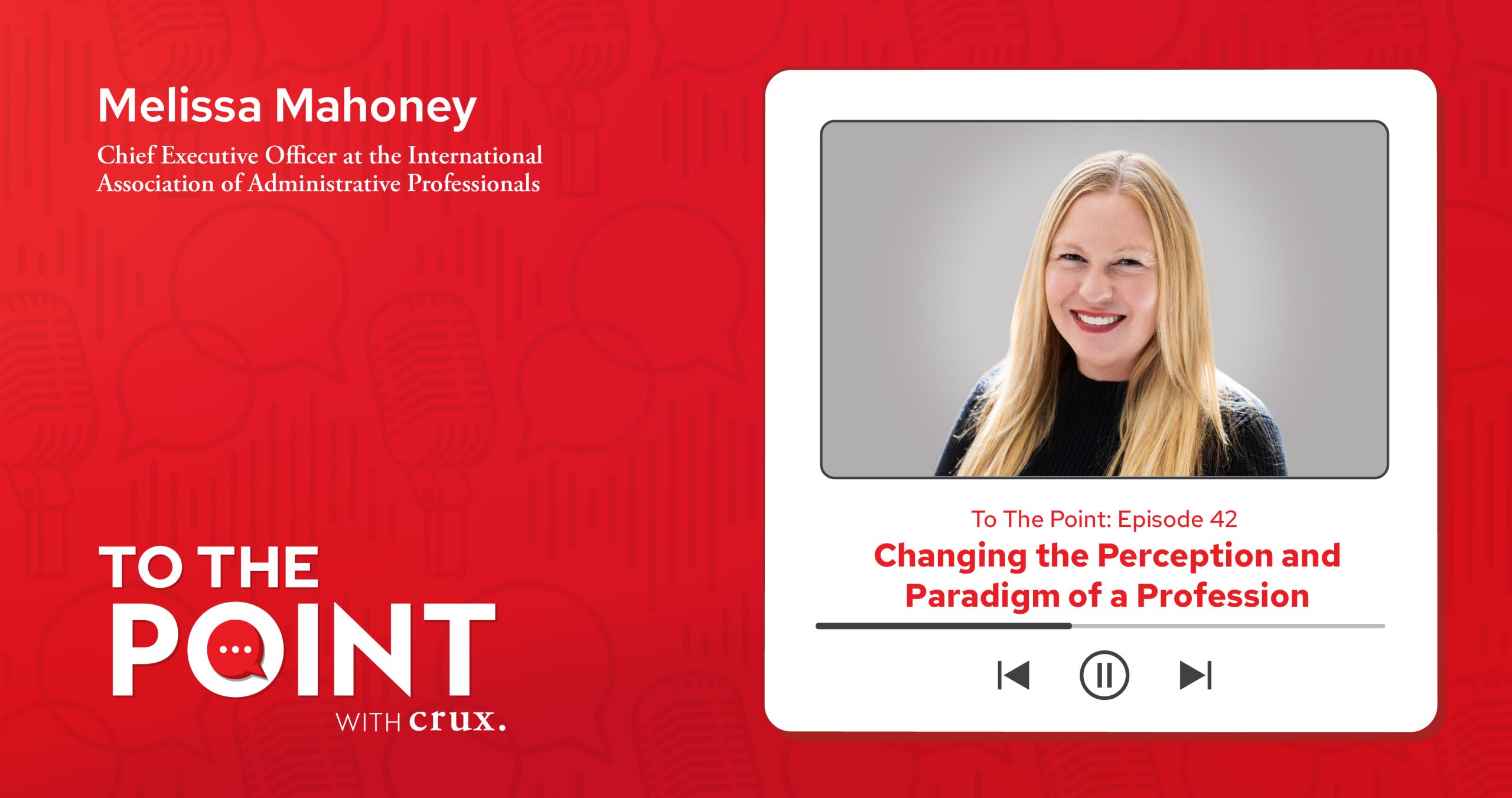
Could the resource your company needs to drive greater profit already be supporting the C-suite? On the latest episode of To the Point, Ethan Whitehill, President & CSO of Crux, speaks with Melissa Mahoney, CAE, the Chief Executive Officer at the International Association of Administrative Professionals, about the perception most executives have about role of admins and how admins can be true strategic partners to executives. With a background that began in elementary education, Mel went from working as an administrative assistant herself to being the CEO of an international professional organization focused on advancing the perception of that role.
Ethan Whitehill: Welcome to our podcast. I’m Ethan Whitehill, President and Chief Strategy Officer at Crux, the un-agency. We built our fractional model to help companies that are ready for intentional growth. Here on To the Point, we get to the point with entrepreneurs, leaders, and marketers who have transformed organizations and, in some cases, entire industries. Our guest for episode 42 is Melissa Mahoney, CEO of IAAP, the International Association of Administrative Professionals. Mel’s path to CEO began as a Montessori teacher where she learned firsthand how people actually learn, grow and build confidence. When she transitioned into the business world through an administrative assistant role, she brought that developmental lens with her, and it fundamentally shaped how she sees leadership. In 2015, she earned her certified association executive credential, which launched her into a career of formal leadership roles within IAAP, but what sets Mel a part is her conviction that leadership isn’t a corner office or a box at the top of an org chart. It’s a mindset, a practice, and something that can and should be cultivated at every level of an organization. With over 20 years in association management with IAAP, Mel has built a career around a simple but often overlooked idea: organizations thrive when they invest in human experience, not just performance metrics. Mel, it’s an honor to have you on the podcast.
Melissa Mahoney: Thank you so much. I’m excited to be here.
Ethan Whitehill: You didn’t set out to lead an international association. You started as a kindergarten teacher. How did that journey eventually lead you to IAAP, and what made you realize that this was just meant to be?
Melissa Mahoney: Great question. One that I get quite often because the transition from kindergarten teacher to CEO of a professional association is not a common pathway. I will say there were lots of reasons why I left teaching, but what connected me to the work that we do at IAAP is rooted in the psychology around education and how people learn, and that is a big part of what we do at IAAP when we’re talking about development and training of admins. There’s a core component of that that’s just revolving around how people grow and develop and learn, and that really sparks joy for me, so it was an easy connection.
Ethan Whitehill: And it’s an easy connection that has lasted about 20 years.
Melissa Mahoney: 20 plus.
Ethan Whitehill: Advocating for administrative professionals. So what’s the biggest misconception that you’ve observed in that time as you think that executives have about executive assistants and how they work together?
Melissa Mahoney: There are a lot of things about the profession that are kind of elusive. It has evolved. I think we all can think about the history of the profession and you have access to some sort of secretary role that was very rote. It was a position that was subservient, supported an executive or an office of executives, did pretty rote task work, and the position really truly has changed and evolved, but I don’t think that our paradigm or mindset around the role has followed suit, so I actually think the gap there is where the misconception lies in how we utilize this profession inside of a business, and it hasn’t quite caught up yet to what the role actually can do for an organization. So, what I experience often is we have a lot of administrative professionals who are feeling frustrated because they’re underutilized and then we have a lot of executives who are feeling frustrated because they’re not getting what they want or need out of their admin. And that gap exists sort of in that paradigm around what we believe that the role is capable of, what we want from that role, how we actually recruit for that role, what we’re asking folks to do when we put them in that role. That gap is the misconception that IAAP is really focused on trying to resolve.
Ethan Whitehill: So in terms of solving for that gap, you’ve often said that the best executive assistant relationships are strategic partnerships, not simply support roles. And we’re not in the Mad Men era anymore.
Melissa Mahoney: Exactly.
Ethan Whitehill: It’s totally different. What separates a truly high performing executive/assistant partnership from an average one?
Melissa Mahoney: I mean, some of it is the executive and whether or not the executive is ready to partner in that way. So, I like to talk about the role as an extension of the executive office, not necessarily as a support of the person or the function because once you take it out of the subservient context, then it opens up like a whole new world of what the possibility is for that role. So, you really should be looking at it as a duplicator or multiplier of your function as an executive. When you have an executive that is prepared for that, totally changes the dynamic of what the administrative professional can bring to the table.
So that strategic partnership, it’s both sides. The admin also needs to be prepared to show up in different ways, needs to be listening differently when they’re in a meeting. They’re not there to just take notes. They really need to be part of the cognitive reflection of what’s happening in that meeting space and can walk away, and while they have a different role in terms of action from that meeting, they need to have access to what happened in the meeting versus a one-dimensional, I’m just taking notes about what just occurred in that meeting. So it, it changes the dynamic when both players are showing up ready to partner.
Ethan Whitehill: And thinking about that partnership in terms of what the executive can do to actually enhance that relationship, what are some mind shift changes maybe that need to happen on the part of that executive? How should they think about engaging that administrative professional differently?
Melissa Mahoney: The extension piece is a big one, so really unpacking your paradigm around how you view that relationship and, if you’ve got any of that subservient mindset in there, you really need to unpack it and try to figure out if that’s truly what you want from the role. There’s nothing wrong with that, but that changes who you recruit, how you recruit them and then what you’re asking them to do.
Ethan Whitehill: And is that even a different title then?
Melissa Mahoney: Probably not an executive assistant. That’s probably more of an assistant administrative assistant position. So I do think you need to get really honest with yourself first and foremost about what it is that you want in the role and in what the barriers are that might be preventing you from actually finding that partner. And if you are really saying like, “Look, I’m not interested in the rote responsibilities.” Because let’s be honest, in the modern world, I book my own travel at this point. They’re all on an app on my phone. It’s actually more work sometimes to have my EA need a code to log into something.
Ethan Whitehill: Been there. Yeah.
Melissa Mahoney: Yeah, it doesn’t make sense to spend the capacity and time on those things. But man, when they’re in the room with me and we leave a meeting and I know I don’t have to worry about bringing them up to speed on why we’re doing this strategic thing, they’re already in the car with me on that and then they can go to work on XYZ action items. It changes how we work together. Calendaring is another great example. Like there’s a part of calendaring that depending on the executive. If you’re tech savvy, you don’t really need someone to go in and manage your calendar necessarily. You need someone who understands why you have meetings, when you have them, when something needs to shift, when there’s a priority that is going to be critical and it takes precedent over everything. Those are the types of things you need access to, not necessarily just the scheduling part or just managing the components. So there are pieces here where both parties need to really inspect what is it that I actually want from this role? What’s going to be a true benefit for me? And if you’re looking for an extension of your capacity, what do those things look like for you? That’s different based on what type of business you’re in. That could look like client-facing work. That can look like tracking how many widgets you’re selling this quarter. There’s lots of different access points. You’ve got to discover what those things are for you that’s going to be a benefit in your ecosystem.
Ethan Whitehill: It sounds like it really is dependent on the skillsets of those two parties.
Melissa Mahoney: It is.
Ethan Whitehill: And probably beyond the job description, it almost sounds like you’re recommending having a conversation with the person that you’ve hired and really decide what is the best way to work together in that fashion.
Melissa Mahoney: Absolutely. And some of those conversations, it would be so much more beneficial if you knew on the front end before you hire someone. Because we do often see that too: like anyone’s an admin, so any admin can do this job. That’s actually not true. There’s so much of a relational component to this type of partnership that you need to be able to articulate this specific type of person is the person I need to support me in this role. If you can articulate that on the front end, you’re gonna save a lot of heartache and heartburn navigating through some of those politics and relationships.
Ethan Whitehill: But that’s hard. It requires introspection. You have to look at yourself and say, “What do I need?”
Melissa Mahoney: Exactly. That’s not the funnest thing in the world to do either.
Ethan Whitehill: You mentioned technology and how it does make our lives easier and makes it easier to do some of those administrative things. AI is obviously affecting a lot of industries. And I think rather than looking at AI as a threat to executive assistants, you see it as an opportunity.
Melissa Mahoney: We’re already seeing that play out in the workplace. You know, it is a threat. There is a risk there. I think there are a lot of jobs that are sort of at risk, and we are on the front line of that risk assessment because a lot of the work is work that could be done with AI. And if you really look at the role in a strategic partnership lens, a lot of that stuff was already the things that were being made more efficient by tools and resources. So even before the true introduction of AI, the admin role has always been on the front line of technological advancement. So when computers became—like that’s a whole story. You, we have so many members of our community who are experienced seasoned admins who will tell you about their experience when computers hit the workplace, and they were the ones who were allegedly on the front line to be eliminated by computers. And then they were the ones that actually adopted computers first and figured out how to integrate them into the office. Usually that fell to the administrative workforce. Same thing.
Ethan Whitehill: They became IT managers.
Melissa Mahoney: They did, essentially. And the same thing has been true for every advancement in technology throughout the years. So, I do think there are some things if an administrative professional is not willing to embrace and learn the technology, then they will probably be obsolete because you have to figure out how to work with it and how to use it to your advantage, and then it can be a massive opportunity for growth. It can actually push them further into that strategic partnership lane and quicker than we’ve ever experienced in history, and we’re already seeing that play out. So now really is the time to be talking about this role as a partnership because of AI. So I actually think it’s an opportunity on both sides.
Ethan Whitehill: What are some of the more creative ways you’ve seen executive assistants using AI?
Melissa Mahoney: I mean, all of that task-oriented work that they were doing, writing and editing and proofreading even, those are really time-consuming things if you’re doing them manually. So I think on the front side of it, there’s a really obvious hours that are being saved just by not having to proofread, not having to deal with grammar, not having to edit documents as much. But the interesting part about that is it does give them access to, when they do review, because you do want human eyes on all of this stuff, we all know that AI is not perfect, you’ve seen the examples, heard the stories about people putting out false information, so there is a brand credibility issue here. And when you have those human eyes that are connected, truly connected to strategy, they get to look at that information differently than just rotely for errors, for omissions, for inaccurate information. They can connect it back and give you something really meaningful in terms of feedback around what you’re sharing, what documents you’re providing, what decks you’re creating depending on what it is. It’s richer.
Ethan Whitehill: What’s interesting to me too is, and we see this in our industry and how AI is starting to change how we work, if you know how to do the thing originally, you can prompt that AI better than somebody who’s never done it.
Melissa Mahoney: Exactly.
Ethan Whitehill: So I imagine you’re getting a much better product as somebody who’s been there done that as an executive assistant.
Melissa Mahoney: Exactly. Yeah. Even the prompts around proofreading, you would be shocked to see how some executives who have never proofread before are using AI to proofread, and it’s very one-dimensional because they have never performed that task before. Proofreading is an art and a science at times. You really have to know what context you’re proofreading. You need to know the basics of fundamental grammar and which type of grammar are we looking at? Admins already have access to that. They can write a richer prompt just on the front end quicker than an executive can spit out a proofread document. So that intellectual capacity is really beneficial.
Ethan Whitehill: So in light of all that, you believe that many organizations are reducing their administrative talent exactly at the wrong time.
Melissa Mahoney: Exactly.
Ethan Whitehill: So what do businesses lose when they underinvest in this?
Melissa Mahoney: Again, I go back to that concept of being an extension of the executive office and that I can actually directly draw a line between that and your bottom line. So if you think about the executive function inside of an organization, it’s literally tied to achieving whatever the priority is. It generally revolves around making a profit, but that profit comes from something. So whatever your strategies are, think about the extension if you have a partner in that space that doesn’t have an executive salary. They should be paid fairly and they’re not carrying an executive salary. They’re carrying a fraction of that and can produce results for your priorities, your bottom line. So it’s a math problem here that to me seems very obvious. But I just don’t think people are using it or viewing it in that way. And so it’s less obvious when you’re just looking at a P&L statement and you’re like, “Well, this is staffing expense that we can cut.” Yeah, but that staffing expense could be—It might not be now—but it could be connected to producing more profit.
Ethan Whitehill: Yeah, the return on that investment could be significant.
Melissa Mahoney: Yes.
Ethan Whitehill: If you actually analyze it.
Melissa Mahoney: Yeah. If you really do the math.
Ethan Whitehill: So I thought this was interesting from our earlier conversation too. When you think about folks entering the workforce and someone whose early career, you’ve described the administrative profession as almost a business apprenticeship and there’s opportunity and a pathway with that. Talk about that a little bit.
Melissa Mahoney: So I view the administrative profession sort of adjacent to a trade because it’s not required that you have a four-year degree to enter this profession. You know, there’s some benefit to that, but we all know what’s happening in the education environment. It’s becoming less and less accessible from a financial perspective for kids coming out of high school to even access a four-year degree. This profession actually gives folks a pathway into the business environment, which traditionally has been gate kept for people with a four-year degree. You think of business and you think everybody in this office probably has a college degree. This position offers a different pathway for people, so it is accessible. And then that entry point actually can springboard folks into a career they hadn’t even thought about. So they get access to all aspects of the business. Then they start to learn, do I actually enjoy this administrative role? Do I wanna be an executive administrative assistant one day? Do I wanna be a partner to the CEO? Or is marketing kinda my jam? And do I wanna pursue something in the marketing field? Or is accounting or operations more my jam? It really does lend itself to access to all of the ecosystems of business and then people can go wherever they want, and they have this unique perspective of having worked in the administrative function first.
Ethan Whitehill: And it probably doesn’t have to be people who are new to the workforce either.
Melissa Mahoney: No.
Ethan Whitehill: It could be someone who’s transitioning career or coming from another field—
Melissa Mahoney: Exactly.
Ethan Whitehill: That might be interested. Any examples of that?
Melissa Mahoney: Yes. I mean, I am a perfect example of that. My trajectory was teacher to administrative assistant to now CEO. And there are a lot of people in our community, who I would say actually at this point in time, it’s more often that people are changing careers and entering this profession than starting it from a choice coming out of high school, which is something that IAAP is really focused on. We want it to be both. We want it to be somewhat equal to create that pathway and that pipeline. And it’s pretty common. We’ve got nurses, we’ve got teachers, we’ve got administrators, people who are coming from all different kinds of other positions or professions who are finding this is actually a sweet spot for me. This is actually what I enjoy doing. So that happens more frequently actually than just coming out of school and saying, “This is what I wanna do.”
Ethan Whitehill: So if somebody’s thinking about an executive assistant, again, they should ask themselves, “What do I really need in this role?” And then you have this opportunity to get somebody who’s got a lot of life experience.
Melissa Mahoney: Yeah.
Ethan Whitehill: If they’re shifting careers and moving into it. So as we wrap up, if every CEO and founder and executive listening today really took one piece of advice from you, what is the thing you want them to know first and foremost?
Melissa Mahoney: It’s that value—that value proposition. So do the math. Like really sit down and do the math around what you’re hoping to achieve and how you can use this role to truly be an extension of your office, your work, what you are producing on behalf of the organization. This person, there’s so much potential return on investment here. It just takes a little bit of introspection, like figuring out what you actually want from the role. And math. Like really sit down and think about what the value is and then that will connect you. That for me then solves this issue around the perception of the role, which there’s a whole nother part of that around the administrative professional, themselves, and how they view their own value. But from the executive’s perspective, it’s literally math. Like it’s very accessible to do that assessment for yourself to figure out how you can utilize that role to create more return.
Ethan Whitehill: So now that got me curious. To find these people that are amazing, do you use regular job boards? Where do you post for that?
Melissa Mahoney: I mean, IAAP has a career center with a job board attached where you’ll find lots of administrative professional positions that are posted. But you know, again, it depends on what you’re looking for and why. And the other interesting thing about that question is there are a lot of headhunters and/or recruiters who focus solely on placing executive-level EAPs—executive administrative partners. And there’s a reason for that because it is so relationally dependent that there’s an art and a science to finding that partner and really getting into the executive’s head and figuring out what it is they want and need. There’s a lot of benefit to using a recruiter for a role. And if you think of it at that level as an extension of the executive office, why wouldn’t you? You’re recruiting executives. Recruit your partner too. And while IAAP doesn’t do that, there is something in that supports and fulfills our mission.
Ethan Whitehill: I think that’s awesome advice. I’ve never heard that, as you’re recruiting executives, think about the assistant as well.
Melissa Mahoney: Yes.
Ethan Whitehill: Yeah. That’s wonderful. I’m gonna get in your head a little bit now. So this is mystery question time I warned you about this.
Melissa Mahoney: Yes.
Ethan Whitehill: You can roll this giant—
Melissa Mahoney: Oh, good.
Ethan Whitehill: 20-Sided die. And it’s a 12. Great question. A city you’d love to get lost in for a day.
Melissa Mahoney: Well, this is super easy for me to answer. Chicago is by far and away my favorite city on the planet that I visited. Now I haven’t visited all the cities. But it is a city that is near and dear to my heart, and we visit there often. And no matter how many times I have been there, we see something new and something like life-altering every time we go. Like the architecture, the people, the culture, the food. There is something new there. We’ve probably been there at least a hundred times, and I have that experience every time that I visit that city. So I literally have gotten lost in that city before and love it every time.
Ethan Whitehill: It is a great food city. I totally agree 100%. Mel, how can our listeners connect with you if they want more information on IAAP?
Melissa Mahoney: First and foremost, find me on LinkedIn. Melissa Mahoney is my profile name. That’s a great place, especially for executives to kind of get a feel and a vibe for what we do. I post a lot of content. IAAP posts a lot of content out on LinkedIn. And you can message me there. But also we have a website. iaap-hq.org is our website. There’s a wealth of information about there. The website is geared towards admins, so if you have administrative folks in your office, that’s the resource I would say they need first and foremost. They need to get out there and discover the training, the certification, the things that we really offer to develop and grow administrative professionals. Everybody who’s working in the profession needs access to it.
Ethan Whitehill: Wonderful. Well, thank you for joining us on the show today.
Melissa Mahoney: Thank you for having me. This has been fantastic.





Kansas City | Phoenix | DC | Austin | Omaha
Headquarters
2345 Grand Boulevard
Kansas City, MO 64108
816.381.2600
info@findyourcrux.com
Mailing Address
2380 McGee Street, Suite 350
Kansas City, MO 64108